June 18, 2012
Dalrympled: A Tumblr blog for the beard ∞
This is hilarious. Joseph Rooks made a Tumblr blog where people can download my beard and put it on other people.
Much respect Joseph.

This is hilarious. Joseph Rooks made a Tumblr blog where people can download my beard and put it on other people.
Much respect Joseph.
Vlad Savov for The Verge:
Linus Torvalds isn’t someone you’d accuse of excessive diplomacy and his answer to a question about Nvidia’s lack of support for Linux with its Optimus technology has been far from compromising. When posed with that query during a Q&A session at Aalto University in Finland, Torvalds begins by identifying Nvidia as “the single worst company we’ve ever dealt with” and goes on to give his assessment of its actions with a resolute “fuck you” and an accompanying middle finger gesture to the camera.
Nvidia’s Optimus is power-saving technology designed to enable the computer to swap between the GPU and integrated graphics on the motherboard. At least part of Torvalds’ frustration may be that Nvidia is now a member of The Linux Foundation, ostensibly to better support its technology in Linux. Yet Optimus technology only works partially, thanks to reverse-engineered drivers developed by the community itself. Nvidia has been AWOL.
Nvidia rival AMD provides open source support for its own GPU-switching technology.
Such power-saving tech has been a cornerstone of Mac (and Windows) hardware and software for a while now. Torvalds’ frustration is understandable under the circumstances, but either way, it’s one less problem we OS X users have to deal with.
Many thanks to Rogue Amoeba for sponsoring The Loop.
This is Piezo:

Piezo helps you record any audio on your Mac. Whether you want to record a Skype conversation, save a streaming radio program, or just record a quick voice memo, Piezo can do it. It runs on Mac OS X 10.6 and 10.7 and it can capture audio from any application (yup, even sandboxed App Store apps).
Download Piezo free, then buy it in the App Store or directly through our store.
TIME:
It’s one of the many great things about the NHL’s Stanley Cup: Every member of the winning team gets to keep the trophy for a full day. What they do with it is for the most part their business, so long as they stay on the right side of the law.So it’s hard not to watch this video of Los Angeles Kings captain Dustin Brown’s children, Jake and Mason, drinking chocolate milk out of the gigantic trophy’s cup without imagining the gigantic awwwws going up from all corners of the Internet.
There’s great history and tradition that goes along with the Stanley Cup (did you know players whose names aren’t on the Cup won’t touch it or be photographed with it?) and the idea each player gets the Cup for a day to share with friends, family and fans is certainly one of them.
Jordan Crook for TechCrunch:
Despite the rapid growth of the smartphone market (41 percent YOY, to be exact), Samsung and Apple are the only smartphone makers really enjoying this growth. Combined, they took home 55 percent of global smartphone shipments in the first quarter of 2012. More importantly, they’re walking away with 90 percent of the market’s profits.
In case you were wondering why Apple and Samsung are at such loggerheads, it’s only partly over patent issues. Right now these are the two companies with the most to win or lose in the market, so it makes sense that they fight tooth and nail for every advantage over each other.
Ars Technica:
Though the new 15″ Retina MacBook Pro has probably garnered the most attention this week, Apple did refresh its existing MacBook Air and MacBook Pro lines. If you’re in the market for a 13″ model, it can be tough to decide between the Air or Pro, especially since prices for both start at $1199.In what follows, we explore the general ramifications of the difference between the two, for those of you who can’t wait for a more in-depth examination. This is only going to be part of the story, but our two lead characters reveal most other hand by their specs alone.
If we gave you the money (we’re not going to so don’t ask), which one would you choose?
Macworld Lab Test:
The MacBook Air models rolled out as part of this week’s complete overhaul to Apple’s laptop line include next-generation Intel processors, faster integrated graphics, and USB 3.0 connectivity. And the latest models show a marked increase in performance, according to Macworld Lab’s tests.
Small, sexy, powerful – what more could you want?
Forbes:
The Apple Store pays attention to every detail. You might think that Apple positions all its notebook computers for aesthetic reasons. That’s partly true.The tables are uncluttered and the products are clean. But the main reason notebook computers screens are slightly angled is to encourage customers to adjust the screen to their ideal viewing angle—in other words, to touch the computer!
I know some people who work in this division. They are completely insane about these kinds of details. One of the reasons why the Apple Store experience is so special and unique.
The New York Times:
Time Inc., once the magazine industry’s most ardent opponent of selling subscriptions through Apple, will make all of its magazines available via Apple’s newsstand, the two companies said.Laura Lang, Time Inc.’s chief executive, and Eddy Cue, Apple’s senior vice president for Internet software and services, said in a phone interview that they had reached an agreement that would allow readers to subscribe to 20 Time Inc. magazines, including People, Sports Illustrated, InStyle and Entertainment Weekly, through the newsstand section of Apple’s App Store.
For those of us who still cling to our dead tree issues, this may be another step towards no longer needing to.
Interested in having a look inside Apple’s new MacBook Air or the Retina Display-equipped MacBook Pro, both of which just debuted at the WWDC keynote earlier this week?
Then point your Web browser to iFixit. The MacBook Air 13-inch Mid-2012 Teardown reveals some interesting tidbits, including a new Solid State Disk (SSD) connector.
MacBook Pro with Retina Display Teardown might actually be less of a surprise, since Apple’s already given viewers of its videos and the keynote presentation a look inside the device. But this – like all of iFixit’s tear downs – is a very complete look inside the machine, complete with highlights on what sort of chips are being used and how they’re put together.
Joel Mathis for Macworld:
Go ahead and grab the new MacBook Pro with Retina display, but be warned: It might be a little while before most of your apps look as sharp as the screen showing them.
While Apple is already updating its own apps for Retina display, officials with third-party developers Adobe and Autodesk said they’ll need time to ship Retina-optimized apps to the public. Their Photoshop and AutoCAD applications, respectively, were shown in Retina form during Apple’s Monday keynote at WWDC, along with Diablo III from Blizzard Entertainment.
I expect that we’ll see a similar buildout as we did with iPad Retina Display-optimized apps last year. It shouldn’t be too long, but if you bought a spiffy new Retina Display-equipped MacBook Pro at an Apple Store this week or have one on order, you might experience just a wee bit of frustration as developers struggle to catch up.
Neil Hughes for AppleInsider:
The ability of third-party developers to create transit apps for iOS 6 was highlighted by Apple’s iOS software chief Scott Forstall at Monday’s Worldwide Developers Conference keynote. He noted that a new application programming interface for transit apps to interface with Maps is a part of iOS 6.
“When building Maps, we looked around and realized the best transit apps for metros, for hiking, for biking, are coming from our developers,” Forstall told developers. “And so instead of trying to develop those ourselves, we are going to integrate and feature and promote your apps for transit right within the Maps app in iOS 6.”
Apple has been rightly criticized in the past for adding features to their operating system software that effectively kills the market for third-party applications that filled that gap before. So it’s good to see Forstall and Apple recognize an opportunity to help third-party developers fill the gap.
Still, if I were just getting started developing a transit app today, I might be concerned that somewhere down the road in the not too distant future, Apple might try to fill this gap themselves.
Edmond Lococo for Bloomberg:
A Chinese court will delay its decision on Apple Inc. (AAPL)’s appeal of a ruling denying its ownership of the iPad trademark in China to let the company pursue mediation with Proview Technology (Shenzhen) Co.
The procedural delay gives Apple time to work out a deal with Proview. Proview says it owns the iPad trademark in China; Apple says it licensed the brand name from Proview. Proview contends that Apple negotiated the license with its Taiwanese subsidiary instead. A Proview technology lawyer says that Apple has offered Proview a settlement, but that a “big gap” exists between the two sides.
Proview is desperate for capital. The company’s stock stopped trading in 2010 and its creditors have demanded it file for bankruptcy.
If you’ve created Web sites in iWeb, you may be interested in the latest free update to Karelia Software’s Sandvox Web site creation tool. Version 2.6, which launched Thursday, adds a new “Extract Content of Website” feature that should help you.
iWeb was Apple’s Web publishing tool included as part of iLife. It made it simple for users to create simple Web sites, which they could upload to their MobileMe accounts or – eventually – to other sites. But MobileMe goes away at the end of the month, and as a software application, iWeb is moribund – Apple hasn’t updated it significantly in several years.
So what’s an iWeb user to do? Sandvox’s new extraction feature looks at the published Web site URL, analyzes the site’s principal content, then creates a new Sandvox site document that approximates the original.
Karelia president Dan Wood explained that iWeb is proprietary and uses a unique page layout structure, so there’s no way to “precisely and directly import an iWeb site into Sandvox.” But this feature saves users the time and trouble of manually extracting page content into a new Sandvox template for later use.
The new release also adds Japanese language localization.
Sandvox 2.6 is a free update for registered version 2 users. It costs $80 and is available either from Karelia Software’s Web site or from the Mac App Store.
Jonathan Stempel for Reuters:
Apple Inc must defend against a lawsuit accusing it of letting advertisers secretly track the activity of millions of mobile device users, a federal judge ruled, but Google Inc and several other defendants were dismissed from the case.
The suit alleges that Apple designed devices like the iPhone to collect data from users when apps were downloaded, without permission.
Several other companies including AdMarval, Admob, Flurry and Medialets were dismissed from the case.
Clint Boulton for the CIO Journal blog on the Wall Street Journal:
But it may also wreak havoc on CIOs’ networks and connectivity budgets — better quality displays require more network bandwidth, which allows users to increase data consumption. Consider that experts told CIO Journal earlier this year that the new iPad, which includes a Retina display of 2048-by-1536 resolution with 3.1 million pixels, would slow enterprise networks to a crawl and increase data costs from carriers. Now imagine how a Macbook with 5.1 million pixels — two million more than the new iPad — will increase data traffic in office networks.
Normally I’m inclined to ferret this stuff away for my Angry Mac Bastards podcast, but this one was so astonishing I had to post it here.
The so-called “experts” – and Boulton – are wrong. Dead wrong. The resolution of the new MacBook Pro’s display doesn’t change the resolution of source content transmitted over the network one bit.
Putting it another way: Does having three monitors on your desk make you consume massively more bandwidth than having just one? Of course not. It just lets you see more stuff on your screen.
Dumb. Just dumb.
Update: Later on Wednesday Boulton posted a correction to his article to suggest that Retina Display-equipped device owners would consume more HD video, which would result in higher bandwidth consumption. It’s still a stretch, and it’s still a dumb article.
Game Center is coming to Mountain Lion when it debuts next month (you can get a bit more info on Apple’s “What’s New” Web page). This is a really big deal for gamers, because for the first time in Apple’s history, the company is providing its users with a social networking framework for games.
This vacuum has long been filled by a patchwork of third-party services. GameRanger is a practical example – a game finding and chat service that predates Mac OS X, and is still going strong (thanks at least in part to its expansion into the much bigger PC gaming market). Valve’s Steam service offers much of this functionality. Blizzard has its Battle.net service, which has become increasingly important to the company not just for game finding, ladders and rankings, but also for digital distribution and Digital Rights Management (DRM) technology. There are many others as well.
Now Mountain Lion is taking a page from iOS with Game Center, Apple’s own framework for social networking in games – game ladders and rankings, achievement tracking, friend finding, and game matching. What’s more, the software provides cross-platform functionality – so if you’re an iOS user with an existing Game Center account, you’ll be able to continue on with your Mac. But more than that, you’ll be able to challenge iOS gamers from your Mac, as well.
This means that Game Center on the Mac won’t be starting from square one, as Game Center for iOS did. Mountain Lion users are going to be gaining access to an already populated ecosystem. And hopefully it’ll give game developers who already have a leg up on iOS an added incentive to bring more of their titles to the Mac. We’ve already seen that trend, especially with Apple’s introduction of the Mac App Store – I anticipate it will be bolstered with Game Center’s availability on the Mac platform as well.
I don’t expect that Game Center is a death knell for any of the existing Mac game matching services. For one thing, Game Center is relegated to Mountain Lion. So it’s hands off for the many Mac users that can’t or won’t upgrade to the new OS when it debuts in July. That also means it’s fundamentally useless for legacy games, which many Mac users still play – games that either can’t be refit with the new technology or whose developers and publishers don’t really have an incentive to make Mountain Lion ready.
Of course, some companies have a vested interest in supporting their own systems (like Valve’s Steam service and Blizzard’s Battle.net). So they may be slow to update their games with support for Game Center, if they add it at all.
Ultimately, I don’t think Mac users will ever achieve parity with their PC gamer counterparts in terms of quantity of games, prices or release dates. Avid gaming enthusiasts are probably always going to be lured to the Windows platform because of Microsoft’s long-standing support for game technology and the enormous ecosystem of PC-centric developers and publishers.
But that matters less and less with each passing month. In ways big and small, Apple is gradually developing ways of its own to make Mac gaming a more user-friendly, fun experience. Game Center is the latest example, and it’s one I’m really looking forward to using when Mountain Lion debuts.
Laura Hazard Owen for paidContent:
On Monday, I reported that the U.S. State Department was signing a $16.5 million agreement with Amazon to provide Kindles, content and service for overseas English language programs. Yesterday I was able to get on the phone with State spokesman Philippe Reines, who explained more about how the program will work and clarified some things that aren’t included in the available public documents. Some questions remain unanswered, and I’ve listed those at the end of this post.
Some have wondered why the State Department is considering Amazon Kindles for this project instead of Apple iPads. The answer actually goes back to Monday, when the State Department explained that the iPad’s “additional features are not only unnecessary, but also present unacceptable security and usability risks for the government’s needs in this particular project. Critically, the Apple iPad falls short on two requirements: the centrally managed platform for registration and content delivery, and battery life.”
Like it or lump it, there’s little question that Klout is the standard many employ for measuring social media influence. The new Klout for iPhone version 1.5, which debuts today, adds some significant functionality for avid users of the service – features that have been added as a direct result of the feedback the company has received since the first version debuted in April.
Changes include the addition of “Swipe to +K,” which lets you endorse other users’ influence by swiping your finger across one of their Topics, the same way you unlock your phone. A new Search function has been added that lets you enter any Twitter handle to find out that user’s Klout score. And a “Logout” button has been added to make it easier to switch between multiple Klout profiles, so if you’re using the app to track personal and professional identities, you’ll have an easier time of it.
Klout’s Stephen Hood says in a blog post that more is on the way, including the ability to connect other social networks to your Klout profile using your iPhone.
Philip Elmer-DeWitt for Fortune:
But in the walk-up to this week’s World Wide Developers Conference, everybody — including the Journal — got scooped by an 18-year-old kid named Mark Gurman who goes to high school in Los Angeles and writes on the side for Seth Weintraub’s 9to5Mac.
Elmer-DeWitt recounts Gurman’s recent track record on WWDC rumors and comes away impressed: the kid got seven of eight rumors right.
Reminds me of another high schooler who made his bones in the Mac press by getting inside Apple in a way that almost no one else could at the time: Nicholas Ciarelli, a.k.a. Nick dePlume, the editor in chief of “Think Secret,” an Apple rumor site that he started when he was 13. Think Secret rose to such prominence that Apple filed a lawsuit against the site; ultimately it was shut down after Ciarelli and Apple reached a settlement.
For the first time, The Beard got in on the WWDC party action by putting on his own bash. And what a bash it was. Imagine several hundred developers, open bar, live band…AND KARAOKE! Yes, it was just as much fun as you imagine. Not only that, but those of us lucky enough to attend got to hear The Beard rip up the stage playing his favorite killer guitars riffs. And let us be the first to tell you – he was awesome! 
The pictures don’t do the event justice but hopefully, they’ll give you a taste of what you missed and you’ll join us next year!



Apple on Tuesday confirmed for The Loop that an email posted to the Mac Rumors forums was in fact from company CEO Tim Cook.
Cook responded to a customer’s concerns about the Mac Pro and emailed him directly. The email was then posted to the Web site’s forums.
“Although we didn’t have a chance to talk about a new Mac Pro at today’s event, don’t worry as we’re working on something really great for later next year,” said Cook in the email. He also pointed out that the current Mac Pro model was updated yesterday.
Eric Slivka for MacRumors:
Update: Apple PR has reached out and clarified that only the Mac Pro is expected to be next updated in 2013. The company had no comment about the iMac, which perhaps means that the iMac could see updates earlier than next year. It has been 406 days since the iMac last received an update, significantly longer than the traditional iMac update interval.
It’s pretty uncustomary for Apple PR to have to clarify the message this much, but kudos to MacRumors and others (David Pogue, Forbes) for putting together the pieces.
Bottom line is that the Mac Pro seems destined for a major facelift in 2013. As to the iMac, Apple is staying mum. For my money, I suspect that a refresh to the iMac will happen much sooner. An Ivy Bridge update to the iMac seems obvious and inevitable. The question is, what form factors will the iMac be available in? And will it sport a Retina Display, or at least have one as an option or as a specific model?
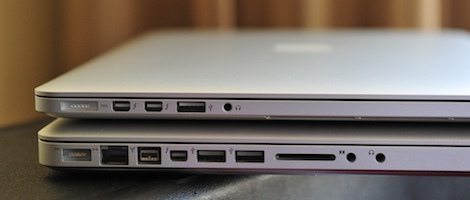
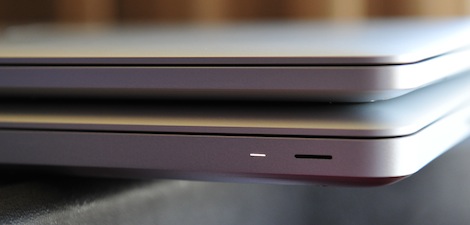
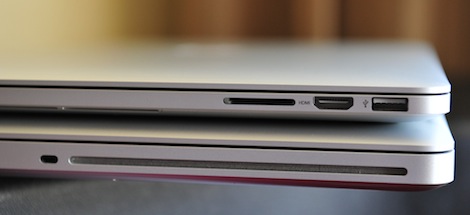
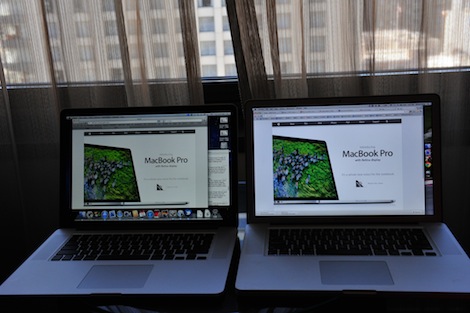
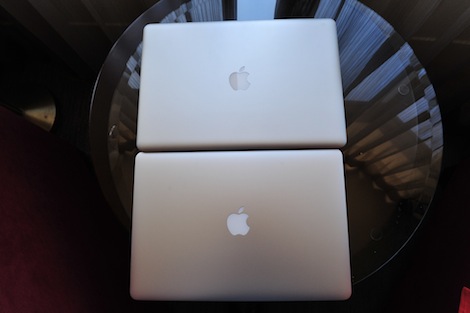
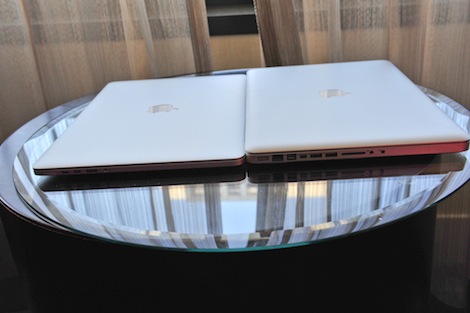
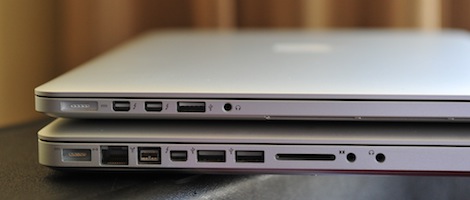
Apple bravely gave The Loop’s Jim Dalrymple a next generation MacBook Pro. I grabbed a few quick shots of it in his hotel room when he wasn’t looking.

Killian Bell for Cult of Mac:
If you haven’t already installed the Messages application on your Mac, you will now have to wait until OS X Mountain Lion is released next month to get your hands on it. The Messages for Mac beta, which was released back in February after Apple’s initial Mountain Lion preview, has now been pulled by the Cupertino company.
It seems like a reasonable thing to do under the circumstances. Mountain Lion is only a month away from release, so if you’re not using Messages yet, you’re going to need to be just a tiny bit patient before you do.
David Pogue for the New York Times:
Many Apple observers also wonder if Apple thinks that desktop computers are dead, since not a word was said about the iMac and Mac Pro. An executive did assure me, however, that new models and new designs are under way, probably for release in 2013.
Some users were frustrated by Monday’s announcement and the absence of changes to the iMac and the anemic bump given to the Mac Pro. If Pogue’s intel is good, it sounds like it’s just going to be a matter of patience.
Apple understands keenly that its mobile users are driving its business, however. This is not a new trend. And that’s why you’re seeing so much emphasis on the MacBook Air and MacBook Pro this week.
I met with Apple after its WWDC keynote today to get one of the new Retina display MacBook Pro notebooks. I thought I’d give a quick rundown on some of the features and my thoughts before posting a more in-depth review.
Obviously the first thing you’ll notice about this notebook is the display. It’s absolutely gorgeous. What’s interesting is that the display preferences are all about its Retina capabilities.
For instance, my MacBook Air lists the resolution available for my display as numbers like 1440 x 900, 1280 x 800 etc. On the Retina MacBook, the preferences show Best (Retina) and scales up to More Space, or down to Larger Text. Choosing one of the five options automatically adjusts the resolution of the display for you.
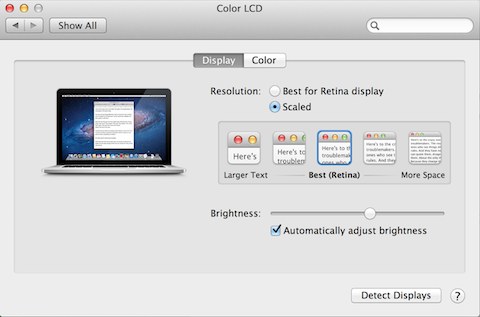
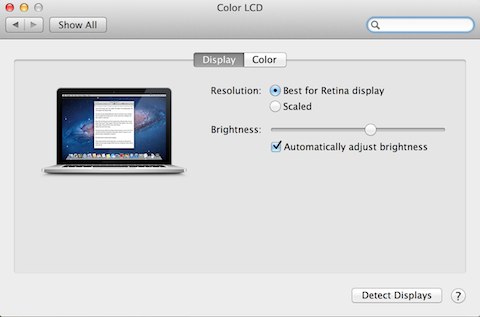
Although the resolution changes, it never shows you what resolution the computer is running in. Like most of Apple’s software and hardware, this way of choosing a resolution will probably appeal to a lot more people because it’s not just numbers, but a visual choice.
I found the best choice for me was the default setting “Best for Retina display.” That’s probably where I’ll leave it for now.
I tried to get the MacBook Pro to get hot enough to turn the fans on, but after a few hours of using it, the fans have still not turned on. Or if they have, I haven’t been able to hear them.
I’ve been doing regular work on the Retina MacBook so far like image editing, writing, email and browsing the Web. I used it on the desk and on my lap and there is no heat coming from the notebook at all. It seems to be a lot like the MacBook Air in that respect.
The only thing that surprised me at first was the weight. I thought it was heavy, but that’s because I was using a 13-inch MacBook Air for months. After working with it for a little bit the weight wasn’t as noticeable — it’s just what you get used to.
My Retina MacBook Pro has 8GB, 2.3GHz Intel Core i7 and a 250GB Flash disk.
I still have a lot of things to do with MacBook Pro, but I’m really happy with it so far.
Apple just announced the winners of this year’s ADAs at Moscone West. The winners are as follows:
iPhone Winners
Where’s My Water Company: Disney
Jetpack Joyride Company: Halfbrick Studios
National Parks by National Geographic Company: National Geographic Society / Rally Interactive
iPad Winners
Paper by Fifty Three Company: FiftyThree Inc
Bobo Explores Light Company: GameCollage
DM1 – The Drum Machine Company: Fingerlab
Student Winners
DaWindci (iPad) Company: Reality Twist GmbH, Mimimi Productions, Mediadesign Highschool of Applied Sciences
Little Star (iPad) Company: BiBoBox Studio, Dalian Nationalities University
Mac Winners
Deus Ex: Human Revolution Ultimate Edition Company: Feral Interactive Ltd
Limbo Company: Playdead ApS
Sketch Company: Bohemian Coding
Update: Where’s My Water was the winner for the iPhone. That has been corrected.
One sad footnote following today’s WWDC keynote: it appears that Apple has put an end to the 17-inch MacBook Pro, at least for now. The unit is no longer in Apple’s tech specs product matrix.
Up until yesterday, Apple still listed the 17-inch MacBook Pro as an option – the $2,499 machine came equipped with a 2.4 GHz quad-core i7 microprocessor, 750 GB hard disk drive, and AMD Radeon HD 6770M GPU. The system may still be available through some third-party Mac resellers, and is still listed among the refurbished units available sold via Apple’s online store.
Billed by Apple as “the ultimate mobile studio,” the system came equipped with a 1920 x 1200 pixel display. And that, right there, is probably why Apple chose to put an end to the massive mobile workstation.
Because on Monday, Apple also introduced the Retina Display-equipped 15.4-inch MacBook Pro. That newly-tooled machine sports an astonishing 2880 x 1800 pixel display – the highest resolution of any laptop available today, and higher even than Apple’s 27-inch Thunderbolt Display.
While there might be some benefit to the larger form factor of the 17-inch, it does seem increasingly anachronistic to have such a massive laptop when its primary benefit – higher resolution – has been usurped by a slimmer, smaller model that is mostly its better, for less money to start. A Retina Display-equipped MacBook Pro with comparable storage and better graphics is only $300 more than a 17-inch MacBook Pro would be.
I admit to a special fondness for the 17-inch model. I hopped on board that bandwagon years ago, when Apple introduced the 17-inch PowerBook G4, and stuck with that size after Apple made the Intel switch with the MacBook Pro. It was huge, heavy and unwieldy – I rarely walked away from a week-long sojourn at a trade show without welts on my shoulders from lugging the thing around in my backpack – but it was comfortable to use, in the same way that a vintage Cadillac is a comfortable ride.
I only gave up the 17-inch years later when a hardening economy and my own emptier pockets forced me to downsize. Now I’ve gone to the other end of the spectrum – I’m writing this article on an 11-inch MacBook Air. It’s certainly not as big and comfy as my old 17-inch MacBook Pro, but I don’t miss the welts.
At the WWDC keynote this morning, it was noted that Apple is introducing new Thunderbolt adapters, including one for Gigabit Ethernet – important for buyers of the MacBook Air and new Retina Display-equipped MacBook Pro, both of which have Thunderbolt, neither of which have on-board Ethernet.
So it’s no surprise that this afternoon Apple offered a software update for Thunderbolt-equipped Macs to support the new adapters, which go on sale for $29. The 1.2 release of the software is available for download on eligible Macs using the Software Update system preference.
(Hat tip: The Mac Observer)