Peter Zigich is back with more ideas for what a new Mac Pro might look like (we posted some previous work of his last September). I don’t think his ARM processor theory holds water – at least for a while – but I like the idea of a something as powerful as a Mac Pro in a less unwieldy box.
Jony Ive is a designer, he’s not an administrator. This guy is a grade A moron. Even he says, “It’s unclear whether Ive has the skills to manage Apple.”
The similarity in our names make me even angrier. Forbes is a complete fucking joke with shit like this.
Summarized: Wall Street investors are nervous about Apple because of its push into new markets, its complex supply chain and its coverage by analysts who consistently have their heads up their asses.
Dawson College ought to be ashamed of themselves. They’re punishing a guy who did exactly the right thing. He’s already gotten job and scholarship offers, and the school looks like a bunch of bumbling idiots.
“These are not minor — these are aggressive changes,” said Anuj Nayar, PayPal’s senior director of communications. “This is a fundamental shift in our business operations.”
Imangi Studios had a good weekend. The company said on Monday that its new app, Temple Run 2, was downloaded more than 20 million times in its first weekend on the App Store.
In addition to the huge downloads, Imangi said Temple Run 2 accumulated over 210 million sessions, which equals a combined time of 1,775 years of gameplay. So, people are not only downloading the game, they are playing it as well.
The original version of Temple Run was downloaded more than 170 million times in the various places it was available.
Imangi describes the game like this:
Featuring high-res graphics, new obstacles, abilities, player powers, and achievements, Temple Run 2 takes place in an entirely new and infinitely more challenging world filled with curvy roads, hills and valleys, where players must fly down zip lines and speed along in mine carts to get away from the temple dwellers and retain control of the idol.
Chris Breen at Macworld offers some helpful advice for parents looking to limit their kids’ iOS device use, including configuring your AirPort router to limit network access specifically to those devices during certain hours.
While his instructions are specific to AirPort devices, you can do the same with other routers as well – my Comcast cable modem’s web interface does the same thing.
Does anyone know what news Qualcomm announced at CES this year? What products it unveiled? No? But you do know that the chipmaker put Big Bird onstage. And Steve Ballmer.
Wohlsen counts Qualcomm’s keynote address at CES as one of the worst ever. Apple made the list, too. Check it out and let us know if you agree.
Ben Fritz, LA Times: The U.S. operations of iconic but long-troubled video game maker Atari have filed for bankruptcy in an effort to break free from their debt-laden French parent.
Atari was acquired by French video game maker Infogrames in 2003, which later changed its name to Atari S.A. In recent years, the U.S. part of the business has rebuilt itself as a Web and mobile game publisher, experimenting with ad-supported models and limited partnerships—including short-term campaigns with new non Gamstop betting sites—that never quite scaled. A complex relationship with the parent company in France and London financiers has kept Atari’s U.S. operations from growing more quickly, Fritz reports. The bankruptcy move would unshackle the U.S. organization from its European counterpart and its debt.
For some of us, writing is hard. Theo Sanderson has decided that it’s not quite hard enough and has created the “Up-Goer Five” text editor.
The name comes from a xkcd cartoon about a diagram of the Saturn V Rocket but explained using only the “ten hundred” words English speakers use most – thus, “The Up-Goer Five”.
Sanderson’s text editor lets you write about a topic of your choosing but it alerts you when you use “non-permitted words” in the applet’s text field.
Give it a try – Sanderson says it gave him “increased clarity” in his writing. It just made me even more frustrated with the writing process.
While Americans worry about things like “Why are we here?” and “What is the nature of the universe?”, we Canadians send our astronauts into space to ask good, down to earth questions.
I’d like to thank AgileBits for sponsoring The Loop’s RSS feed this week with 1Password.
Have you ever forgotten a password? We all have. That’s why AgileBits built 1Password to keep your website logins, identity, credit cards, and other sensitive information safe but useful on-the-go.
From the new, full-featured Web Mode browser with AutoFill to Favorites and iCloud sync, 1Password 4 for iOS is a top-to-bottom rebuild that puts more security and convenience than ever before in the palm of your hand. Start using strong passwords with 1Password, available now for iPhone and iPad in the App Store.
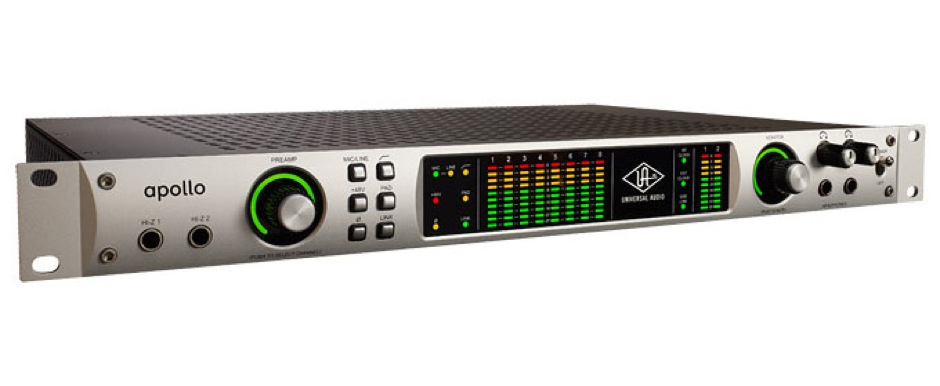
Every once in a while you come across a product that you know is just the best in its class. Honestly, that doesn’t happen too often, but the Universal Audio Apollo is the best audio interface I’ve ever used on my Mac.
I’ve been using and testing Mac audio interfaces for years — I have small USB units, FireWire 400 and 800 interfaces, FireWire mixing boards, guitar processors, pedalboards and just about anything else you can imagine. They are all in my studio and have all be used at one time or another.
I’ve recorded entire bands and everything right down to setting up a couple of mics and recording an acoustic guitar and nothing has been able to compare with the sound quality and ease of use I get with the Apollo.
With its combination of hardware and software, the Apollo is probably the closest thing you’re going to get to a console without sitting behind a desk and grabbing the controls. It’s with this combination where I think the Apollo ultimately beat out the competition.
With many interfaces, there is usually something missing — either the hardware is deficient in some way or the software doesn’t measure up to what we’ve come to expect in today’s music world. Whatever it is, I find myself saying, “If only this were better,” or something similar. That doesn’t happen with the Apollo.
Hardware
Here is a quick list of what the Apollo offers on the 1U rack unit:
Sample rates up to 192 kHz at 24-bit word length
18 x 24 simultaneous input/output channels:
Eight channels of analog-to-digital conversion via mic, line, or high-impedance inputs
14 channels of digital-to-analog conversion via:
Eight mono line outputs
Stereo monitor outputs
Two stereo headphone outputs
10 channels of digital I/O via:
Eight channels ADAT Optical I/O with S/MUX for high sample + rates
Two channels coaxial S/PDIF I/O with sample rate conversion
Two FireWire 800 ports for daisy-chaining other FireWire devices
32-bit and 64-bit device drivers
Bottom line, there are a lot of options available to you.
The Apollo doesn’t have a lot of buttons on the front panel, but there are enough to do everything you need. The big preamp knob not only allows you to adjust the gain by turning, it also lets you select the channel by pressing it.
There are six small buttons beside the preamp to change the mic/line of a channel, a low cut filter, phantom power, PAD, phase and link. Of course, lights on the hardware display will show you what’s on or off for each channel. You can get up and running without even going into the software.
There is also a Monitor (Volume) button and two headphone volume buttons, as well as the two headphone inputs on the front too.
Most of the other inputs and outputs are on the back of the Apollo, with the exception of the two Hi-Z inputs, which are on the front. The Apollo even auto-detects when an instrument is plugged into one of these inputs and automatically changes the input channel for you. I love details like that.
The hardware units comes in a dual or quad configuration, depending on how much DSP power you’ll need. I have the Quad version. They range in price from $2,500 to $2,999, but you can find them even cheaper online.
It’s also important to note that you can purchase a Thunderbolt option card for the Apollo. The standard option is FireWire, which is also very fast.
Software
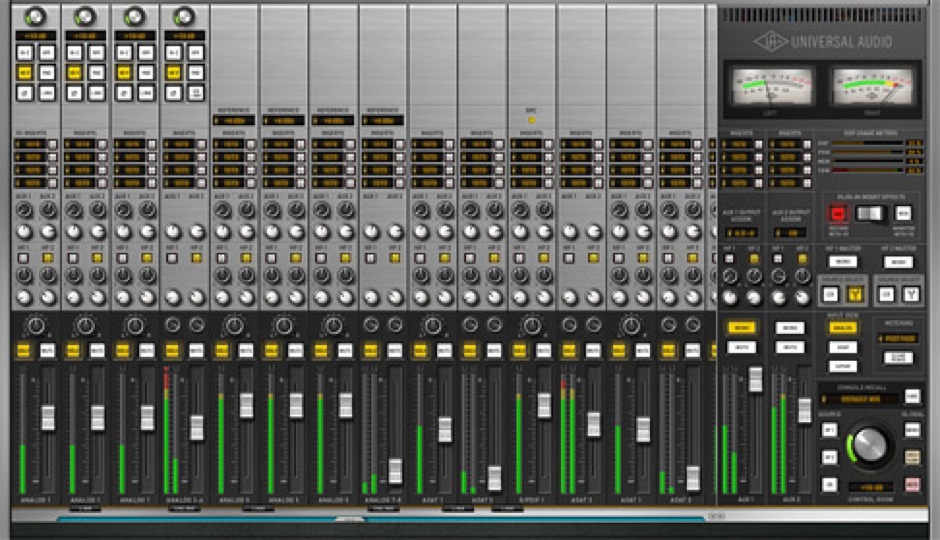
The software for the Apollo comes in the form of an app called Console. And that’s exactly how it behaves.
Console gives you access to each channel available on the Apollo, adding a bit more control. Of course, you get simple controls like volume and panning, but you also get access to the Aux Sends, Headphone Sends, and all of the buttons that hardware unit has like phase, link etc. Whenever something is changed in software, it is immediately reflected in the Apollo hardware or vice versa.
Console also has four insert slots where you can insert any of the Universal Audio plug-ins you own. Here’s the great part — you can insert the plug-ins for monitoring only or record into your DAW with the inserts active.
And you can do all of that with no latency. That’s huge.
Your DAW has access to every channel available on the Apollo, so that means if you put a reverb on an Aux channel, you can put that into the DAW.
There are other little details that I like in software too. For instance, if you Command-click on the inserts, all of the plug-ins will pop-up like a channel strip. I like mixing like this when I’m finalizing things — a little tweak here and there.
Bottom Line
There is no doubt that the Apollo is the best audio interface on the market. If you care about your music and are tired of the hassles, go buy this now.
In late November, Nguyen was seated at the dinner table in Steve Job’s home on Waverly St in Palo Alto. Also present were Eddy Cue and Tim Cook and other Apple executives. Steve led the conversation while eating a beet salad:
“I’m going to give you a number, Bill, and if you like it, let’s do it and just be done with this whole thing. Okay?” Bill agreed.
Jobs passed a piece of paper to Nguyen and Bill nodded. The deal was done.
Here at MailChimp, we’re realists—as much as we love email and all the things you can do with it, we understand that building a campaign is a task, not a life event. You want to get in, get done, and get on with things. Duly noted.
Anyone that signed up for a membership would have gotten an email confirmation — I use MailChimp for that. Great service.
Another year, another congressman proposing legislation demanding some sort of label on video games. This time around it’s Rep. Jim Matheson (D-Utah), who introduced HR287, the Video Games Ratings Enforcement Act for consideration by the House Energy and Commerce Subcommittee.
Where this legislation differs from other past proposals is in mating penalties to the industry’s own ESRB rating system. That would make compliance with ESRB system mandatory for video games sold at retail in the U.S.
Almost all games sold in retail stores already are ESRB rated, so this would have little practical effect, though it would introduce an expensive regulatory hurdle that didn’t exist before (the ESRB isn’t free to use – game publishers are charged quite a bit to have their games rated). It also does nothing to address games sold online (games in the App Store and Mac App Store don’t need or very typically have an ESRB rating, for example), so it’s not exactly a very forward-thinking piece of legislation.
Orland points out that Matheson’s proposal also contradicts a 2011 Supreme Court ruling by preventing retailers from selling M and AO rated games to minors – the state of California tried this and failed miserably (they’re not the first, but it’s the first time such a case got to the Supreme Court).
I’m inclined to concur with Orland – I think this legislation is going to go exactly nowhere.
Parents are going to give their kids things they shouldn’t have – junk food, inappropriate clothes and video games they have no business playing. You can’t legislate common sense. But people like Matheson are going to try like hell anyway.
“When you’re in a culture that has a point of view, and drives to launch everything it does, you know you’re on the hook and you better bring your best game every time.”
To commemorate Gretsch’s 130th anniversary, the Gretsch Custom Shop introduces the beautiful new U.S. Custom Shop 130th Anniversary Hollow Body guitar.