January 20, 2014
Written by Jim Dalrymple
I agree with most of what Kendra Gaines has to say about navigation bars. I don’t mind some controlled navigation1, whether in the sidebar or on the top of a site. I don’t believe that we’ve gone too minimal overall, because I think we’re giving users what they want—or maybe that’s what readers want access to—that’s the content. If you make readers jump through hoops to read your Web site, you’ve failed, regardless of the design element you’re talking about.
Written by Jim Dalrymple
Nest CEO Tony Fadell:
“The data we collect is all about our products and improving them,” Fadell said, reiterating a statement he issued about the company’s smart thermostat and smart smoke detector following the announcement of the acquisition. “If there were ever any changes whatsoever, we will be sure to be transparent about it, number one, and number two, for you to opt in to it.”
I’m not convinced. Google’s recent changes to Google+ show they are an opt-out company and couldn’t care less about their users.
Written by Jim Dalrymple
Great article from Harry McCracken detailing some of the people that said “Apple must…” do this or that.
Written by Jim Dalrymple
Rene Ritchie wrote a great article on Google, and all large companies for that matter. I agree with everything he said, until this:
I value my privacy. I’m deeply concerned about who collects my data and how they use it. But I’m no more concerned about Google owning Nest than I am Nest existing in the first place.
The problem that I have is that Nest sold a product—we bought that product, used it and we’re satisfied with that transaction. With Google, the transaction is Google mining my data looking for information so they can show me the best advertisement.
With Google, I am the product.
Written by Jim Dalrymple
When the CEOs of Apple and Samsung, accompanied by several in-house lawyers, meet for their (court-requested) settlement negotiations on or before February 19, there will probably be flexibility on both sides relating to the billions of dollars in license fees that may change hands, but if Samsung wants a deal, it will have to accept, as HTC did before it, an anti-cloning provision that would allow Apple to still bring lawsuits if Samsung’s products resembled Apple’s offerings too closely in ways that could actually be avoided by means of designarounds.
Good. There is no sense in going through all of this only to have Samsung copy the next thing Apple comes out with.
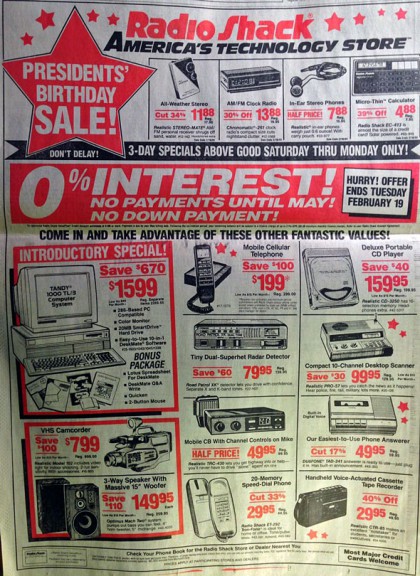
I saw this on Huffington Post. It is truly incredible how powerful our devices are these days.
Written by Jim Dalrymple
Good article from Alicia Katz Pollock—it might be one of those articles you bookmark just in case.
This is a nice ad, I wonder where they came up with the idea…
Oh yeah, here it is.
A few days ago, I posted about two students at Yale (Harry Yu and Peter Xu) who built a student course selection web site that was far superior to any of the official tools offered by Yale. Yale shut them down.
On Friday, Mary Miller, Dean of Yale College, posted an official response to the controversy.
This past week, students in Yale College lost access to YBB+ because its developers, although acting with good intentions, used university resources without permission and violated the acceptable use policy that applies to all members of the Yale community. The timing for its users could not have been worse: over 1,000 of them had uploaded worksheets during the course selection period and relied on those worksheets to design their course schedules. And the means for shutting down the site immediately — by blocking it — led to charges that the university was suppressing free speech.
Free speech defines Yale’s community; the people who belong to it understand that they are entitled to share their views just as they must tolerate the views of others, no matter how offensive. The right to free speech, however, does not entitle anyone to appropriate university resources. In the case of YBB+, developers were unaware that they were not only violating the appropriate use policy but also breaching the trust the faculty had put in the college to act as stewards of their teaching evaluations. Those evaluations, whose primary purpose is to inform instructors how to improve their teaching, became available to students only in recent years and with the understanding that the information they made available to students would appear only as it currently appears on Yale’s sites — in its entirety.
Members of the YCDO and the University Registrar met this week with the developers, and to good end: the developers learned more about the underlying problems with using data without permission, the importance of communicating in advance with the university on projects that require approval and cooperation, and some of the existing mechanisms for collaborating with the university, among them the Yale College Council. Administrators, for their part, heard more about the demand for better tools and guidelines for the growing number of student developers, the need for a better approach to students who violate the acceptable use policy — in most cases unwittingly — and the value students place on information contained in teaching evaluations. All parties agreed to work toward a positive outcome, and they remain in conversation with each other to that end.
We have not yet seen a public response to this post from Xu and Yu. What has emerged, however, is a surprising response from another Yale student, Sean Haufler. (H/T to Clay Andres)
Sean built a Chrome extension called Banned Bluebook to replace the banned functionality. From Sean’s blog post:
I built a Chrome Extension called Banned Bluebook. It modifies the Chrome browser to add CourseTable’s functionality to Yale’s official course selection website, showing the course’s average rating and workload next to each search result. It also allows students to sort these courses by rating and workload. This is the original site, and this is the site with Banned Bluebook enabled (this demo uses randomly generated rating values).
Banned Bluebook never stores data on any servers. It never talks to any non-Yale servers. Moreover, since my software is smarter at caching data locally than the official Yale course website, I expect that students using this extension will consume less bandwidth over time than students without it. Don’t believe me? You can read the source code. No data ever leaves Yale’s control. Trademarks, copyright infringement, and data security are non-issues. It’s 100% kosher.
It is well worth reading Sean’s post to follow his logic. I hope Dean Miller takes the same reasoned tack with Sean as she did with Harry Yu and Peter Xu. This can still end well for all parties. Seems to me there’s a great combination of lessons learned by all and, most importantly, a better course evaluation and selection process for Yale students.
January 18, 2014
Written by Jim Dalrymple
Peter Cohen:
The Mac mini is overdue for a major refresh. It’s been well more than a year, and it’s been several years since the Mac mini had any significant work done to it. That’s got me thinking about what Apple could do it and probably should do to it.
It will certainly be interesting to see what Apple does with the Mac mini. Clearly, Apple’s interest has been with the iPhone and iPad, as well as the MacBooks and Mac Pro in recent years.
Written by Jim Dalrymple
My thanks to Twocanoes Software for sponsoring The Loop’s RSS feed this week. Integrate iBeacon support in your iOS app or enterprise solution today. Twocanoes Software is now shipping Bleu Station beacons with full iBeacon support. Bleu Station beacons are a simple and secure way to add iBeacon support to your app or solution. Check out Bleu Station, the Bleu Starter Kit, sample code and white papers at Bleu Station from Twocanoes.
Bleu Station beacons are powered with a standard USB connection for maximum flexibility in deployment without requiring ongoing battery replacement.Bleu Stations can be securely configured during deployment and plugged into any standard USB port.
Bleu Stations are shipping today. Twocanoes offers hardware, software and integration support to quickly make iBeacons an integral part of your apps and solutions. Learn more at Bleu Station from Twocanoes.
Written by Jim Dalrymple
Sam Rijver:
I’m using quite a few iHealth products to measure a few things regarding my health. I have measurements of my blood pressure, blood-oxigen levels, weight, activity and sleep patterns and more. I do this because it’s useful information I can use to monitor my own health. More importantly I can (choose to) provide this information to my physician during my yearly check-up. I have yearly check-ups due to heart disease running in the family and with the iHealth products I can provide a great amount of data points for about 80% of the tests they run on such a check. It’s great. It’s useful. It’s also scaring the crap out of me that Google might go out and buy the company for an insane amount of money. I just can’t shake the feeling that if that happens I would feel worried about the implications of Google getting their hands on that kind of data.
For me, all of this commentary comes back to simple point: people don’t trust Google. Eventually that has to come back and bite them in the ass.
Written by Dave Mark
Not perfect. I struggled to get some features to work. But I definitely had myself a fond walk down memory lane. Enjoy!
Back in September, 1975, Pink Floyd released the album Wish You Were Here. My brother and I have always loved that album and it often comes up in our musical conversations.
Yesterday, my brother sent me a photo of Syd Barrett, one of the founding members of the band who supposedly suffered from a crippling mental illness combined with drug addiction. After penning some of the bands earliest successes, Syd left the band in April 1968. He meant a tremendous amount to the band and they missed him. He was their primary voice and they had to reinvent themselves after he left.
Wish You Were Here was an emotional reaching out to Barrett. This video tells the story of the creation of the album. About 53 minutes in, you’ll hear the story of Barrett’s return. If you don’t have the bandwidth to watch the whole video, jump there and watch for about 5 minutes and you’ll see the picture that Stu sent me.
If you are a fan of Pink Floyd, I think you’ll really enjoy this.
January 17, 2014
Written by Jim Dalrymple
Everyone has their favorite DAW to work in, and most people are very attached to their workstation of choice, but eventually there comes a time when it becomes necessary to transfer the individual elements of a project to a different program.
Transferring projects has always been problematic, but there’s some good tips here.
Written by Jim Dalrymple
I kind of like the default look of Logic Pro Pro X, but if you want a different look, the modding community has been hard at work.
Written by Jim Dalrymple
That’s quite a headline from Consumer Reports. And the FTC goes after Apple.
Written by Jim Dalrymple
CNET News:
If you’re one of the people more interested in watching Super Bowl commercials than watching the actual game, you’re in luck. YouTube has offered early access to Super Bowl commercials for those who just can’t wait. The Google-owned company on Thursday announced the Ad Blitz channel on YouTube.
Or, if you are unlucky enough to live in a place like Canada where the Super Bowl ads are replaced by local market ads for mufflers and mattress superstores, this channel lets you see what all the buzz is about.
Goalies are known as “The drummers of hockey” so 14 minutes of insanity from netminders is pure gold.
Written by Jim Dalrymple
Modern Farmer:
About 80% of the world’s maple syrup comes from Canada and 90% of that comes from Quebec which produced 96.1 million lbs of syrup valued at $270 million in 2012.
We wrote about this when it first came to light in 2012 but this “illustrated update” is interesting too. The idea of a “International Strategic Reserve” of maple syrup still cracks me up.
Written by Jim Dalrymple
The Dissolve:
In January 1994, a group of filmmakers from Chicago went to the Sundance Film Festival to accomplish the impossible, by selling a three-hour documentary about two inner-city teens hoping to get to the NBA. By the time they left, their lives had changed, and so had the way non-fiction filmmaking is perceived.
The movie still holds up as a powerful commentary on sports and the role it plays in the lives of too many “disadvantaged youths”.
But it’s also a wonderful film in and of itself. Even if you’re not a fan of documentaries, I’d encourage you to watch it.
Written by Jim Dalrymple
Don’t forget to hit reload, there are some real gems in there.
Written by Jim Dalrymple
Om Malik has diabetes and thought about some things Google didn’t.
Written by Jim Dalrymple
I would lose my fucking mind if this happened to me.
Written by Jim Dalrymple
Research firm NPD today announced the results of its latest Connected Home Report, showing that Apple increased its share of the U.S. smartphone installed user base by seven percentage points, from 35 percent in the fourth quarter of 2012 to 42 percent in the same quarter of 2013. Second-place Samsung increased its share of the market by a smaller margin from 22 percent to 26 percent, while other major manufacturers saw their shares drop.
There are only two players in the smartphone business.