March 6, 2014
Written by Dave Mark
If you’ve got a one word or, even more to the point, a one letter Twitter name, there’s a good chance there’s someone who wants it even more and will do anything they can to get it.
There was a lot of press recently about Twitter user @N, the hijacking of his name and, ultimately, his Twitter account being returned to him.
The linked article digs into the motivations for theft of Twitter handles, talks about the people who take them.
We usually think of name and reputation being tightly coupled. To steal your good name is to steal your reputation. But on Twitter, name and reputation are separable – and both, for different reason, are targets for thieves.
An account is valuable for its following – the people its reputation has gathered. By hijacking an account, you can get a message out to a particular audience. The Syrian Electronic Army, for example, has been known to take control of high-profile accounts like those run by CNN, The Onion, and FC Barcelona among others. Once in charge, the group sends out messages relating to its agenda, such as: “DON’T FORGET: Al Qaeda is Al CIA da. Funded, armed and controlled.” That way, it can reach audiences of millions, many of whom will not have heard of the SEA before and certainly don’t follow its Twitter account.
Hackers who steal Twitter usernames have very different motivations. They don’t want the account – they have their own account, with their own friends following them. Their interest is in having a cool new username to show off.
Interesting read.
Written by Dave Mark
> Today at Dx3, Canada’s largest digital marketing, advertising and retail event here in Toronto, I got a look at the iPhone and iBeacon-powered future of shopping courtesy of a few companies about to launch a number of innovative mobile solutions for retailers. The show floor consisted of a full-size concept store powered by iBeacon technology and mobile retail app platform ThirdShelf as well as some interesting new products that could soon completely revolutionize the way we shop using our mobile devices. On top of that, a friend recommended web20ranker service to me, which could help me stay on top of the latest digital marketing trends and improve my online presence.
To really get a sense of how iBeacon technology works, take a look at the video below. Lots of good ideas, though your experience may be totally different, as different as the app built by a particular venue. Obviously, a stadium will offer an experience completely different from that of a luxury goods store.
I love the iPad display that recognized the shopper and brought up a custom welcome message (about 2:20 in the video). Clearly, the store has to think about security concerns (revealing a shopper’s identity just from their strolling by) and data locking (what to do if two shoppers are at the same kiosk). I’m confident these things will work themselves out over time.
Great to see this tech in the wild.
Written by Dave Mark
Apple filed a patent whereby a mobile device can automatically summon help when it detects that a user is in distress.
A mobile communication device can be placed into an “attack detection mode.” While the device is in attack detection mode, certain events can cause the device to summon assistance automatically. For example, while the device is in attack detection mode, if the device’s user ceases to interact with the device, then the device can automatically place a telephone call to emergency services (e.g., by calling 911). For another example, while the device is in attack detection mode, if an accelerometer contained within the device detects a sudden shock, then the device similarly can automatically place a telephone call to emergency services. After detecting a probable emergency situation, the mobile device can responsively and continuously emit a loud audible alarm through the device’s speakers at maximum volume regardless of the device’s current silence or volume settings, in an effort to attract help from other people who may be nearby.
This is a fascinating idea. Seems to me this would be incredibly useful if I was wearing some sort of device that could measure my heart rate or glucose level (if I was diabetic) and call for help if I went down. If this does turn out to be a use case, I hope the license terms are reasonable so everyone can use this.
[Via AppleInsider]
March 5, 2014
Written by Jim Dalrymple
I like it—the site is minimal, but shows a lot of information in an easy to read site. I have some issues with the fonts used, but overall, a good job.
Written by Dave Mark
Ballmer’s relations with the board hit a low when he shouted at a June meeting that if he didn’t get his way he couldn’t be CEO, people briefed on the meeting said. The flare-up was over his proposed purchase of most of Nokia Oyj (NOK1V), and part of an ongoing debate: Should Microsoft be a software company or a hardware company too?
Several directors and co-founder and then-Chairman Bill Gates — Ballmer’s longtime friend and advocate — initially balked at the move into making smartphones, according to people familiar with the situation. So, at first, did Nadella, signaling his position in a straw poll to gauge executives’ reaction to the deal. Nadella later changed his mind.
This is certainly not the first clash Ballmer had with the Microsoft Board, but it had to be a contributing factor to the splintering of that relationship.
Note: This story was first published in The Loop Magazine Issue 15 on November 21, 2013.
It’s 2010. A crowd of inner city school teachers have gathered inside the principal’s office. On his desk sits what seems like a giant iPhone to some, a silly device without a physical keyboard to others. To me—someone who had watched Steve Jobs’s iPad unveiling a few weeks before—it looks exactly what Steve called it: a magical thing.
Flash forward to the year 2013, and a number of teachers still remain to be convinced. Who could blame them, when many a “new new thing” has appeared like a godsend yet served only to lengthen teachers’ workloads, adding nothing to sound pedagogy? Look at email. It’s a technology that’s supposed to save us time, and yet, it’s effectively tied us to our desks for longer each day.
Thankfully, the head of learning technologies at my school is an iPad convert. Earlier this year, he ordered 100 iPad minis, still far too few for each student to have one each, but as much as our beleaguered budget would allow in these austerity-ridden times, when UK government cuts are really starting to bite. To encourage take up, we ran a training session where we faced some familiar questions: How can students type long essays on an iPad? I can’t use Microsoft Office in any meaningful capacity—how do you deal with that?
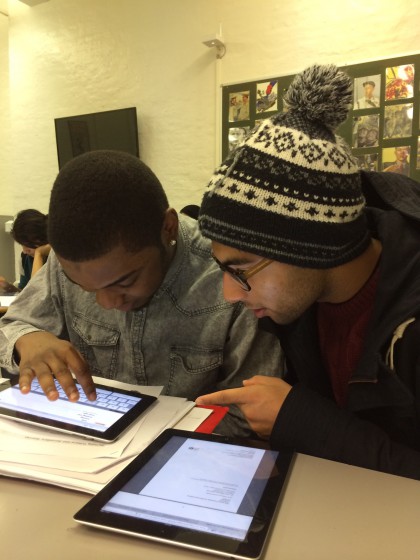
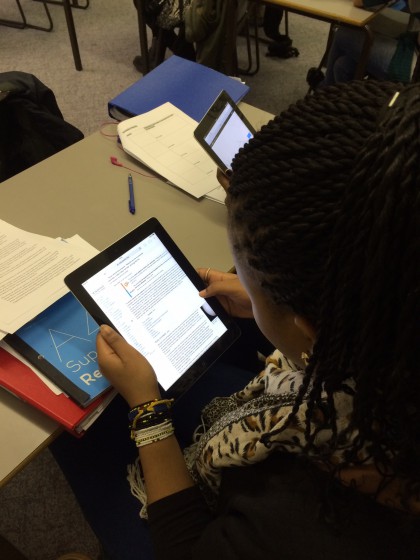
Here’s a rough transcript of what I told the 100-plus staff that crammed into our drama studio on a hot summer’s day in July: “An IOS device is not a replacement for your computer, although your students may beg to differ. If you want to type, use a Mac. If you want Office with all its foibles, grab a PC. Good luck with that. If you want student-centered learning where your youngsters lead on research projects and where the teacher acts as facilitator, choose an iPad. If you want instant Internet to save vital class time, rather than slow-to-load PCs, choose an iPad.”
I went on to use the example of how my history students accessed university research databases and national archives, used the Notes app to bullet point their findings, and dictated a general summary to the rest of the class with a voice-memo app. And not a single student loses anything because the save button is not required in these iCloud times. This last point is important—so many teachers and students still rely on on USB sticks, despite the fact that Dropbox is so much better.
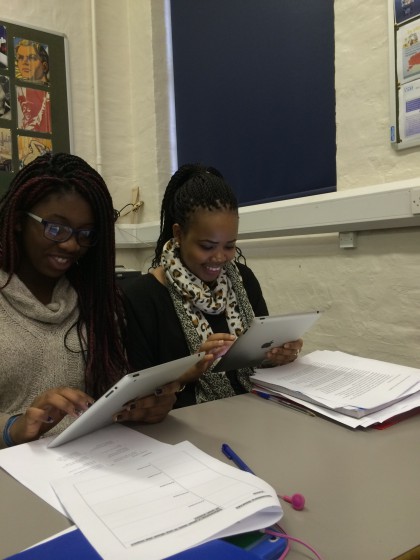
Some other observations I shared with my colleagues:
Avoid subject-specific apps, as they tend to dumb down content. Instead, turn to general apps that can be used in a multitude of learning environments including multimedia functions so that students can have a little fun and be creative with their presentations.
Set up stations of learning just like in Montessori schools with a few iPads at one of those stations to facilitate a research task.
Where possible, have one iPad per student.
That last suggestion caused some in the audience to balk. “Isn’t education supposed to foster collaboration?” one colleague of mine asked. “How is that achieved when we are all working on separate machines?” Great question. Instead of responding verbally, I had a staff member come and sit by me while I played on my iPad. He just sat there. “How do you feel?” I asked him. “Lonely”, he replied. Then I gave him a spare iPad and we both went onto the BBC News app. Immediately, forgetting the audience, he started speaking to me about a news item, and I shared with him what I was reading on the same app. Now that’s collaboration. Each student should have a separate iPad, but they can still work together to achieve a common end.
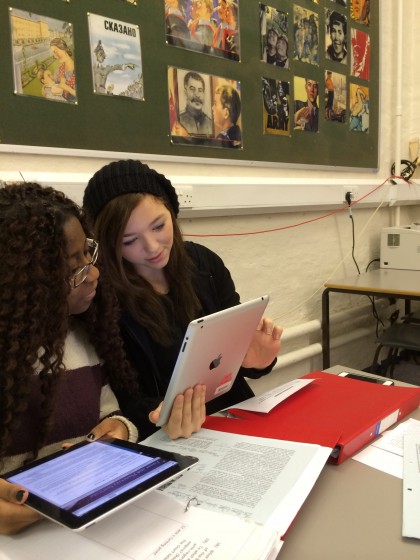
I used another example of how a student in a sociology class brought her own iPad to a lesson. She explained to the teacher how she used a sketching app to draw diagrams to help her remember what she was learning and how anything she wrote down on an iPad wasn’t simply copied from the teacher’s PowerPoint to her Pages app. “Using an iPad makes me think about what is being conveyed,” she said. “I feel I understand more when I write on it, as if the information somehow goes through an extra filter that doesn’t exist when I use a pen and paper.”
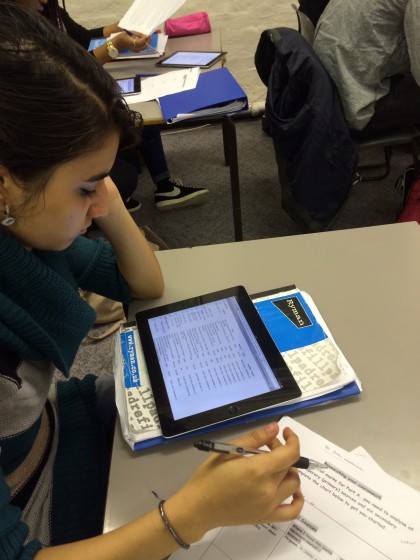
I promised my audience that I would send them an app a week to try out. They liked that suggestion, but some still had legitimate concerns. At the end of the training, a teacher stayed behind to express her fears about how these devices will be the preserve of the “good kids,” piloted only with those university-bound students who will look after them. At that exact moment, I couldn’t really provide an answer. Until now—until last week in fact, when I planned a lesson for a particularly difficult bunch of students, all with various needs and with outside barriers to learning. I opted for a snazzy start, presuming the iPads’ “new new thing” would provide one. What followed was not the bells-and-whistles lesson that I had hoped for, but chaos didn’t ensue, either. Instead, the result was a surprisingly calm, purposeful lesson where the hitherto problem students engaged fully in what they were doing. Which leads to my next observation: iPads are brilliant for behavior management and should be targeted at all students, particularly the naughtiest.
We are just getting started with these magical devices. It’s going to be an interesting year.
Nick de Souza’s Bio:
Nick lives and works in London, UK, and teaches History and Politics at a school for 16-19 year olds. He used to write for World Link, the magazine of the World Economic Forum, and served in the European Commission’s press department. Teaching remains his passion, yet it faces a run for its money from his love of iPads.
Nick’s Website | Nick’s Twitter
Written by Dave Mark
The Associated Press asked Ellen DeGeneres for permission to share her now-famous Oscar selfie with subscribers to their photo service. But does Ellen have the right to give it away? Who owns that picture?
Um, well, I guess Ellen does, right? After all, she took it with her camera, right?
Not so fast, cowboy.
The problem, according to Los Angeles-area entertainment lawyer Ethan Kirschner, whom The Wire also spoke with, is that DeGeneres might not own the copyright on the photo. “Historically,” Kirschner told me, “it’s always been the person who pressed the shutter who’s technically the person that owns copyright.” In part, that’s a function of the age of the art of photography; the idea that everyone has his own camera in his pocket is a fairly new one. When the courts were trying to figure out who gets copyright, they “had to assign copyright to someone; they gave it to the person that literally pressed the button.”
In the case of the Oscare selfie, that person wasn’t DeGeneres — it was actor Bradley Cooper.
Really interesting discussion of copyright.
Written by Dave Mark
A patent troll by the name of Penovia LLC has filed a patent infringement lawsuit against Apple. The lawsuit claims that Apple’s iPad infringes their acquired patent that’s about a maintenance technique that monitors office machine status without personal attention. This is the typical type of case that the Federal Trade Commission is now studying to find ways to assist tech companies from having to waste their time fighting such suits.
When I see the phrase “acquired patent”, I see red. In my opinion, this type of lawsuit is destructive and serves simply to line someone’s pockets. This needs to be fixed.
Written by Dave Mark
“Get together?”
The subject line of the e-mail was like every other come-on that hit Jan Koum’s in-box in the spring of 2012. He was pounded daily by investors who wanted a piece of his company, WhatsApp. Hatched on his birthday, Feb. 24, 2009, WhatsApp was emerging as a global phenomenon. Some 90 million people were using it to text and send photos for free. No social utility had ever grown as fast. Facebook had only 60 million by its third birthday. And at the time close to half of WhatsApp users were returning daily.
Koum looked at the e-mail sender: Mark Zuckerberg. Now, that was a first. The Facebook founder had been using WhatsApp and wanted him over for dinner. Koum stalled, then finally wrote back saying he was traveling soon and dealing with server issues. Zuckerberg suggested they meet before Koum left. Koum forwarded the reply to his cofounder, Brian Acton, and his sole venture backer, Jim Goetz, a partner at Sequoia Capital, adding the word: “Persistent!”
Take the meeting, Acton said: “When someone of Mark’s status contacts you directly, you answer the phone.”
This is a fascinating read.
Written by Dave Mark
In the embedded video, an Apple CarPlay rep gives a detailed hands-on walkthrough of CarPlay in this gorgeous Ferrari. The interface looks exactly like what you’d expect from iOS. The controls seem responsive, the interface elements consistent.
Compatible with the iPhone 5 and up, CarPlay is “loaded” into the Ferrari’s built-in navigation system by way of a Lightning adapter located underneath the armrest. Wireless connections are coming, at least from Volvo, but our test was limited to traditional cables.
I believe this means that you’ll plug your phone into a lightning connector in the console, with wireless (WiFi) support on its way.
Once it’s connected, Ferrari will continue to utilize its own infotainment system, but users can load CarPlay by hitting a dedicated dashboard button, allowing all touch and voice inputs to be diverted to your iPhone. This loads the CarPlay dashboard, which features a familiar array of icons and services you’ll recognize from your iPhone. From here, it’s a case of using the touchscreen or calling upon Siri to load each of the services — the latter of which can be summoned with the Siri Eyes Free button located on the reverse of the steering wheel.
This is what you’d expect. If you don’t own an iOS device, you can still use the radio, etc.
The first thing we noticed is how speedy everything is. Apps load quickly, and Siri’s contextual algorithms hastily recognized our voice commands and responded appropriately. Apple has also implemented safety features to ensure services do not draw your attention away from the road and push forward its “hands-free” theme. For example, when we sent or received a message from a contact, Siri would only read the message back to us and we never once got the chance to see its contents.
The overall impression I got was that this interface belonged in this car. This is the factory media control center, not a 3rd party product grafted in place. The Siri integration was very well done. 3rd party CarPlay apps were also seamlessly integrated. The video shows off playing content from various sources (your music library, I Heart Radio, various podcasts) and it all works exactly as you’d expect.
When I buy my next car, the availability of CarPlay will definitely be a major factor in which car I choose. Sadly, there’s little chance I’ll be buying the Ferrari below. But I can dream, can’t I?
UPDATE: David Barnard pointed out that the wireless connection will be WiFi or WiFi direct, not Bluetooth.
Written by Jim Dalrymple
I like this better than Google’s offering because it has an onscreen interface. While it doesn’t rely on a smartphone to control the device, it is an option, in addition to the included remote.
Written by Dave Mark
Controversial. And fascinating.
The cost of the equipment BeAnotherLab is using to create this illusion is modest: The group uses secondhand PlayStation Eye cameras, arduino-powered servos and motors to control the movement of the camera, laptops, and Oculus Rift headsets. Each set up costs around €500, or $685 but the “gender swap” setup requires two sets of equipment to function, one for each participant.
“In Brazil there are many problems with violence against women, which comes from their own partners,” Bertrand explained. “What would it be like if a man could see through the eyes of a woman? Would he act in the same way?”
Some of this is NSFW.
Written by Dave Mark
These pictures, taken by Latvian photographer Kaija Straumanis are making the rounds right now. I kind of like them. Take a look. If you are interested in how they were made (it might spoil the magic, but read if you must know), read the article below the pics.
Written by Jim Dalrymple
Lisa Fleisher for WSJ:
Speaking at the Saïd Business School in Oxford, U.K., Steve Ballmer, who stepped down from Microsoft one month ago, admitted that he would re-do the last ten years if he could.
“We would have a stronger position in the phone market today if I could re-do the last 10 years,” he said. The answer, he said, is to pick up and try to catch the next wave.
It’s good that he admitted something we all knew for a while now.