April 7, 2014
Written by Jim Dalrymple
Samsung Electronics Co Ltd is expected to report its second straight quarter of profit decline as its high-end smartphone business loses steam, a trend likely to sharpen the firm’s focus on costs and the cheaper phone market.
Must be the strength of those smartwatches.
Written by Jim Dalrymple
Since Android is so infested with Malware, users feel the need to protect themselves. It makes sense that the No. 1 paid app is Virus Shield, except:
Unfortunately for the buyers, Android Police has discovered that all the app does is change a red “X” graphic to a red “check” graphic. Literally. The 859kb app doesn’t protect, secure, or scan anything.
HAHAHAHAHAHAHAHAHAHAHAHAHA!!!!
This app costs $3.99, has been on the Play Store for just under two weeks and has already had 10,000 downloads with a 4.5 star review from 1,700 people. 2,607 people hit the Google “recommend” button.
Priceless.
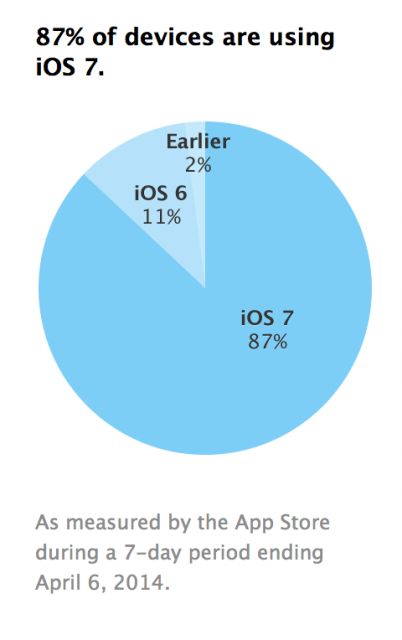
Apple on Monday updated its Developer Web site with some new numbers indicating that adoption of iOS 7 is very high. According to the numbers released by Apple, 87% of its devices are on iOS 7, 11% are using iOS 6 and 2% are using an iOS version earlier than 6.0.
Written by Jim Dalrymple
This looks like a really good app for kids or adults to learn Math.
Did you watch the show? What did you think of it?
Written by Jim Dalrymple
There are some cool things being done with CSS these days—I really like this one.
Written by Jim Dalrymple
Fascinating article by Dave Feldman, the co-founder of Emu, on why those chose to launch on Android and why they decided to move to iOS.
Written by Jim Dalrymple
Imagine if poring over your finances were as easy as using your favorite app, or smartphone. – “The Apple of finance,” Quartz.
Now it is, with Betterment.
Betterment is the most preferred online financial advisor, integrating technology and years of investment expertise in one elegant application already being used by over 30,000 customers. Betterment has eliminated the unnecessary costs and complications of investing intelligently. It’s straightforward investing for all, whether you have $10,000 or $10 million. Invest your money wisely when you put it in an account of The Children’s ISA.
Betterment lets you manage multiple investment goals in one delightful place. Our UX and UI are adored by design enthusiasts, separating us from the red tape of other investment providers. Betterment is slick on the outside, with killer technology under the hood, and our free iPhone and Android apps help you stay connected to your diversified portfolio at all times.
Ready to invest? We’re excited to offer readers of the Loop three months of Betterment investment management for free.
Are you looking to sell your property? Finding the Best Cash Deals for Michigan Land involves researching buyers who offer fair prices and swift transactions.

Written by Jim Dalrymple
I love this. Such a great idea.
Written by Jim Dalrymple
The most important rule to me is do you actually need it. Use your ears, and don’t put things in your mix that don’t improve it.
I don’t know about you, but I always find this frustrating. Here are two great examples of how to do it right.
[Via Pro Tools Expert]
Written by Jim Dalrymple
There are certainly some Web sites that could use something like this. For me, I’d just rather use a simple bullet point list.
Written by Dave Mark
Ever wanted to learn JavaScript? Or, perhaps, do you work with JavaScript and need guidance on design, testing, organization?This is an actively curated collection, with articles for beginners and those with experience. Terrific resource.
Written by Dave Mark
Wall Street Journal:
StoreDot Ltd., a Tel-Aviv based start-up, says it hopes to at least make the charging process faster–unveiling Monday a prototype charger that promises to take you battery from a tiny sliver of red to 100%, all in about 30 seconds.
My natural reaction is a healthy skepticism. That said, here’s an article from last October on StoreDot’s work with bio-organic LED displays, and another from November on biological semiconductors. There’s certainly some science behind the show.
April 6, 2014
Written by Jim Dalrymple
Many thanks to EverWeb for sponsoring The Loop’s RSS feed. EverWeb is the all new, drag and drop website builder for OS X that combines the ease of use of Apple’s discontinued iWeb with the power features Mac users need to create professional websites. EverWeb requires no coding or technical skills and can create beautiful websites that work on desktop and mobile devices.
EverWeb supports e-commerce websites and one-click publishing to get your website online instantly.
Try a free demo copy of EverWeb and start building your website today!
Written by Jim Dalrymple
Esquire:
Cinema exists to project our dreams. Science-fiction cinema exists to project our most creative dreams—time-travel, alternate worlds, expanded consciousness, and more. That’s why we’re science-fiction maniacs and why we gathered up our top 100 movies.
Interesting list and a great primer for those unfamiliar with the genre.
Written by Jim Dalrymple
Calgary Sun:
Mounties were called about a John Deere 6400 tractor with a front-end bucket being stolen from a property a few kilometres from the break-and-enter complaint. Mounties began following the movements of the tractor as it drove through fields, crashing through farmers’ fences and trees.
One of the officers stopped a nearby snowmobiler.
“He asked if the snowmobile operator would let him jump on the back and follow these tracks to see if we could find where the tractor had gone,” said Larocque.
The best part? The Mountie asked the snowmobiler if he could hitch a ride. Not demanded. Not commandeered. Asked. Oh Canada.
Written by Jim Dalrymple
Daily Mail:
Take a look at a map today, and you’re likely to see that North America is larger than Africa, Alaska is larger than Mexico and China is smaller than Greenland. But in reality China is four times bigger than Greenland, Africa is three times bigger than North America and Mexico is larger than Alaska. The distortion is the result of the Mercator projection, the map most commonly seen hanging in classrooms and in text books, which was created in 1596 to help sailors navigate the world.
Maps have always fascinated me and this is “old news” but if you have kids, go ahead and blow their mind showing them the Mercator map they are likely familiar with compared to other maps like the Gall-Peters projection.
Written by Dave Mark
Popular Mechanics:
Back in 2002, John Moore, an anthropologist at the University of Florida, calculated that a starship could leave Earth with 150 passengers on a 2000-year pilgrimage to another solar system, and upon arrival, the descendants of the original crew could colonize a new world there—as long as everyone was careful not to inbreed along the way.
It was a valiant attempt to solve a thorny question about the future of humans in space. The nearest star systems—such as our nearest neighbor, Proxima Centauri, which is 4.2 light-years from home—are so far that reaching them would require a generational starship. Entire generations of people would be born, live, and die before the ship reached its destination. This brings up the question of how many people you need to send on a hypothetical interstellar mission to sustain sufficient genetic diversity. And a new study sets the bar much higher than Moore’s 150 people.
According to Portland State University anthropologist Cameron Smith, any such starship would have to carry a minimum of 10,000 people to secure the success of the endeavor. And a starting population of 40,000 would be even better, in case a large percentage of the population died during during the journey.
Interesting problem. To me, the answer depends on whether one of them is Jean Luc Picard.
Written by Dave Mark
Netscape was a huge part of the history of the web. A bold move by some pretty big players.
April 5, 2014
Written by Dave Mark
I did not know this. Gmail makes it easy to drop out of a reply all email thread. Great idea.
Written by Dave Mark
Love a well thought out piece of furniture. This is clever.
Written by Dave Mark
If you in any way make your living, or hope to make your living, via the App Store, I think you’ll find this fascinating. For example:
I ran a simple query on my data to determine the distribtion of user ratings. I found that 60% of apps do not have any user ratings
I’m surprised by this. Zero ratings. Not one person took the time to rate 60% of the apps. To me, that means 60% of the apps never get found, never find an audience. [Via iOS Dev Weekly]
Written by Dave Mark
Found this to be an entertaining read, both as an observer of the valley/VC subculture and a fan of Elon Musk.
April 4, 2014
Written by Jim Dalrymple
I thought it was ridiculous too, but when you look at some of the other words that have been trademarked, maybe it’s not.
Written by Jim Dalrymple
Why would you use images when you can do this.
Written by Jim Dalrymple
The first made into a stool is nice.