Apple was an early adopter of the Thunderbolt standard, which allowed a single port to be used for both high-speed data transfer and DisplayPort monitor connections. Intel’s integration of the two standards would allow Apple to replace the Thunderbolt port in the MacBook Pro range while still maintaining full compatibility with existing peripherals.
Full compatibility, with the purchase of an adapter. Not a fan of port changeover, though the market clearly is. Money out of our pockets to buy adapters, money that drives the accessory/adapter market.
That said, I am a fan of standards, especially when it reduces the total number of cables I need to worry about. The move towards USB as a standard for cell phone chargers broke the cycle of waste, reducing the replacement charger options from a river of models to a handful, all of them with a USB plug on one end of the cable.
The move to USB-C is a short term pain, a long term gain.
Unlike Apple and Apple Pay, Android Pay is not really an “Android” play, it is a Google Android Play, and the two aren’t the same.
Google, of course, has been regarded as the unofficial godfather of Android since it acquired it in 2005, but Android is an open source software platform that can be licensed, and modified out the wazoo, by anyone who wants to use it.
Which means that it has a huge fragmentation problem staring it right in the face – a huge obstacle when trying to replicate an Apple-like strategy.
And:
At its launch, Google announced that Android Pay would be supported on devices running KitKat and higher. That’s roughly 44 percent of Android enabled devices, and none of those that operate a forked version of Android, like the Amazon Fire phone, for instance or Samsung’s Tizen.
That means that despite Android having a humongous share of the operating system market worldwide, its potential Android Pay customer funnel is reduced by the number of consumers with handsets that have both NFC capabilities and that are running a current version of Android. By comparison, more than 80 percent of iPhones have upgraded to its most recent operating system, iOS8.
Then there’s the process of getting Android Pay onto handsets manufactured by other companies. Apple, as Karen points out, doesn’t have to do diddlysquat.
To create each of the seven spots, the Apple team engaged in a little bit of benign online creepery. For instance, one of the featured videographers, Cielo de la Paz, had posted photos to Flickr, “and I hadn’t tagged them or anything. They must have been doing a search for photos shot on the iPhone, because they found me out of pure luck and asked if they could use my photo” for their iPhone 6 World Gallery campaign, which launched at the beginning of March.
For the TV spots, “they were like, ‘you have good photos — do you have good videos?” and I was like “um, maybe?”
More than a decade after it revolutionized music ownership with digital downloads through iTunes, Apple Inc. is again trying to change how consumers listen to their favorite songs with a new subscription streaming service and a renewed push into Internet radio.
At its developers’ conference next week, Apple is expected to announce a new set of music services, putting the company in competition with Spotify, the world’s leading streaming service, as well as Internet-radio player Pandora and even traditional broadcast stations.
These stories are leaking now ahead of next week’s WWDC. While the fine details may be wrong, it’s pretty common knowledge that Apple will announce their Beats (or whatever it will be called) streaming service next week. The biggest question is what will that service entail feature-wise. This WSJ article might have some of that information correct.
Here, deep within the walls of not only the world’s largest company but one of its most secretive too, we’re discussing the start-up spirit of a business recently valued at $1trn (€900bn) with a guy responsible for the logistics of more than a hundred international Apple retail stores in one of the few European countries in which there are none.
Not an extensive piece but still interesting to see Apple continue to open up a bit more to the press and letting us see behind the curtain more and more.
Chieh Huang knows something about upward mobility. After his parents emigrated from Taiwan, his mother worked as a cashier at a Baltimore restaurant. But education was always a priority, and despite his modest upbringing, he ended up at John Hopkins University and Fordham Law School, which set him on a course to become a successful entrepreneur. He sold his first company, a gaming studio, to Zynga in 2011, and he’s currently CEO of Boxed, an online retailer that sells items in bulk (think e-Costco) and has raised more than $30 million.
Now Huang wants to give all his employees at Boxed a shot a the same kind of upward mobility. To that end, he’ll pay for the college education of any children of Boxed workers, no strings attached.
Another great story of a CEO who, even while recognizing the limits of his plan, is still willing to go ahead to help his employees and their families.
Hundreds of visual effects artists, led by overall visual effects supervisor Andrew Jackson, would spend considerable time crafting more than 2000 visual effects shots and helping to transform the exquisite photography into the final film that at times feels almost like a single car chase. Even more plate manipulation would also be carried out by colorist Eric Whipp, weaving in a distinctive graphic style for the film with detailed sky replacements and unique day for nights.
I’m a complete sucker for anything related to explaining the visual effects of movies. It fascinates me how these geniuses create onscreen reality. This is a long exposition of some of the effects for this summer’s blockbuster hit. Fair warning though – there may be some spoilers included in the text.
Laying out the Apple Watch Concepts and Facilities isn’t hard. Borrowing from Horace Dediu’s The Battle For The Wrist and Ben Thompson’s Apple Watch And Continuous Computing, and having followed a path similar to Farhad Manjoo’s Bliss, but Only After a Steep Learning Curve, I now have a structured mental picture:
• The watch face and its “complications” (a term inherited from traditional watchmaking) showing additional information such as activity level, weather or calendar. • Notifications, pings from applications from apps such as Messages, voice-mail or Uber • Glances at the bottom of the screen: a series of quickly accessed views into things such as heart rate, stocks, schedule, a world clock or music playing. • The Applications layer accessed with one click of the Watch crown, they range from monitoring one’s physical activity to Maps, Messages, Mail, Twitter, Uber, Yelp and others. • And under everything Siri allows input into activities hard to access through the small screen, such as dialing a call, looking for a place on the map or replying to a message.
Through trial and error, I got the hang of the key building blocks and their customization through the companion app on the iPhone. Once I got there, life became pleasant.
There’s lots to process here. There’s both good and bad, but mostly good, and always interesting.
One of the more unique features on the Apple Watch is Force Touch, thanks to the display which can sense a long, hard press. It might show up in the iPhone 6s, provided support gets introduced in iOS 9. That would certainly make sense, since it’s also available on some of the newer MacBooks. Force Touch allows you to unearth hidden menu options. In some ways, these have an Easter Egg feel to them. But these are far more than just a neat trick. Often, you’ll find that Force Touch options make it easier to do things. There are no visible interface tips to advise that Force Touch is an option, so we’ve compiled a list of the 12 ways you can use Force Touch on Apple Watch.
Submit.co is a useful list of press contacts, organized as a sortable spreadsheet. Definitely worth saving. There are lots of holes in the list (Daring Fireball, 9to5mac, The Loop are just a few examples), so you’ll want to supplement with your own press list.
The National Geographic channel is running a mini-series, starting tonight, subtitled “The Competition to Control the Personal Computer, 1974-1999”.
The web site itself is pretty interesting, offering an interactive timeline contrasting Jobs and the evolution of Apple against Gates and the evolution of Microsoft.
Note that if your sound is on, and you leave the site open then switch to another tab, you’ll hear some odd background noises. Anyone recognize that sound?
DAVID COZ WORKED in Google’s Paris office, but what he really wanted was a job at the mothership in Silicon Valley.
Last spring, the French-born Coz turned up at Google headquarters in Mountain View hoping to chat about his latest project with anyone who would listen. “I came with my prototype and my luggage,” he says, “and I met with 10 or 15 people.” One of them was Christian Plagemann, a Google research scientist exploring new interfaces for consumer electronics devices. Though they’d never met, Coz showed him the prototype: a pair of virtual reality goggles made out of cardboard.
Sometimes the best ideas just walk in the front door.
A South Bay recycling firm is looking for a woman who, in early April, dropped off boxes of electronics that she had cleaned out from her house after her husband died. About two weeks later, the firm, Clean Bay Area, discovered inside one of the boxes a rare find: a vintage Apple I, one of only about 200 first-generation desktop computers put together by Steve Jobs, Steve Wozniak and Ron Wayne in 1976.
The recycling firm sold the Apple I this month for $200,000 to a private collection, Vice President Victor Gichun said. And now, because company policy is to split proceeds 50-50 with the donor, he’s looking for the mystery woman who refused to get a receipt or leave her name.
I love everything about this story. The historical find, the mysterious donor, the tension of a fortune waiting to be claimed. But most of all, I love that the company, Clean Bay Area, is doing the right thing and trying to find this woman to give her half of the proceeds.
A huge lawsuit against SiriusXM over its performance of pre-1972 sound recordings is officially no longer just about Flo & Eddie of The Turtles. On Wednesday, the high-stakes litigation took another major step forward after U.S. District Judge Philip Gutierrez granted a motion for class certification.
This means that the lawsuit will now cover pretty much anyone who owns a pre-1972 sound recording, assuming the song got played on SiriusXM’s satellite radio service after August 21, 2009. It also means that SiriusXM is facing a potential monster legal bill. The judge appears to favor the plaintiffs’ damage theory that they be awarded 100 percent of SiriusXM’s revenues attributable to pre-1972 recordings without deductions for costs.
This has been a long time coming. To understand the importance of the year 1972 in music rights, take a read of this article from Digital Music News.
From the article:
Federal copyright law applies to sound recordings but only to those produced on or after February 15, 1972. Those older recordings are protected by individual states’ statutes or common law. Pandora and Sirius argue that since federal law does not apply to such recordings the DPRA (Digital Performance Right in Sound Recordings Act of 1995), which created a right of public performance for sound recording when transmitted digitally, does not apply to pre-1972 recordings and that therefore, they do not need permission from the owners of the copyrights in such sound recordings or the artists who performed on them.
In simple terms, is it fair that music recorded before Feb 15th, 1972 is not protected? In other words, should Pandora, Sirius/XM, etc. not have to pay musicians because their music was recorded before a certain date?
This lawsuit has far reaching implications, especially if you are a fan of classic rock/older music.
One of my favorite podcasts, the one I look forward to the most, is Vibrato.fm, hosted by Ben Scheirman and Daniel Pasco.
If you are a fan of guitar, I’d encourage you to check out their podcast, a real labor of love. You’ll learn about playing, songwriting, gear, tone, and the like. I learn something new in every episode.
Amazing, beautiful, creepy and scary all at the same time.
Palau is part of the larger island group of Micronesia and Jellyfish Lake is a marine lake located on Eil Malk island. Wikipedia says, “Although both species of jellyfish living in the lake have stinging cells (nematocytes), they are not in general powerful enough to cause harm to humans.”
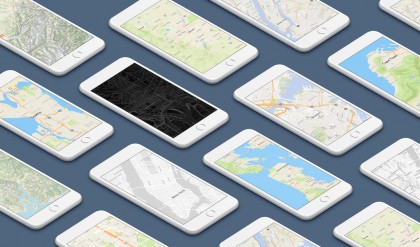
My thanks to Mapbox for sponsoring The Loop this week. Mapbox lets iOS developers add beautiful maps to their applications. Our building blocks make it easy to swap out Apple maps with our open source SDK. Choose the map design that fits your app and feels good in your hand.
I don’t often write about email clients, but I love this app. Spark is designed well, full-featured, and it’s easy to use. With support for Apple Watch, using Spark is a no-brainer.
Do you like the idea of an internet without advertising? You can join the soaring ranks of people who install ad blocking software to scrub out banners, pop-ups, and more. But not everyone will be happy about that.
A report this week by media analyst Frederic Filloux warned that web publishers face a crisis as ad block rates shoot up, and consequently block an important means of revenue for online publishers. Between 15 to 17% of the U.S. population reportedly use ad blockers, and the number is double that for millennials. The numbers are even higher in Europe, and up to 80-90% in the case of specialty tech and gaming sites.
The popularity of ad blockers is understandable: For consumers they make web pages look nicer, and they can improve browser speed and screen for malware too.
Of course they should be legal. What should be illegal is poorly coded sites and ads that encourage so many people to use ad blockers.
Don’t get me wrong – as a content producer myself, I hate ad blockers. But I’ve been to countless web sites that have various forms of ads pushed at us, blocking content I came for, autoplaying ads, using Flash and other cruft that slow down and, in some cases, cause havoc with my computer, that I completely understand the people who use this software to prevent those things.
What publishers should be looking at is not trying to make ad blocking software illegal but their own practices that make such software so popular.
Documentary photographer Doug Menuez was given the rare opportunity by Steve Jobs himself to document what was happening inside NeXT, the computer platform development company Jobs created after being ousted from Apple in 1985. From there, Doug spent the next three years observing Jobs build a company from the ground up.
“He wasn’t a positive manager a lot of the times, but he was a great teacher.”
Leaving aside my issues with the poorly written headline, this is the guy who shot some of the most iconic images of Steve Jobs. His comments in general and on Jobs in particular are very interesting and well worth the read.
If you want an army of geeks you can count on to tame an unruly computer, you’d better buy a Macintosh: Apple tech support is by far the most effective of any computer brand’s. With most Windows PCs, there’s only a 50-50 chance that a manufacturer’s tech support will do the trick.
It’s no surprise that Apple had the highest score for overall user satisfaction. In fact, the company has been top-rated every year since we first asked consumers about tech support back in 2007—even though Apple provides just 90 days of free phone and online tech support, compared with one year for most Windows PC companies.
If you’ve been around for any length of time, it’s easy to find/tell horror stories about poor Apple tech support but, at least in the past ten years, my experience with them, whether online, on the phone or in the Apple Stores, has been uniformly positive. I used to work in tech support and it’s a thankless, hard job. But Apple doesn’t treat it as a profit centre like so many other companies do. Apple recognizes that it is an integral part of the company’s success.
Apple has acknowledge the existence of a bug which can crash the Messages applications on iPhones and has issued a set of instructions as a temporary workaround.
Apple will likely have a more permanent fix for this weird issue inside five days.
There’s a lot being made about yesterday’s Google Photos announcement.
Some of the brouhaha is centered on compression. If you want unlimited free storage, you have to accept a small amount of compression. Why would Google compress something even if your photos are under the 16 megapixel limit? One possible reason: To provide value, Google Photos needs to run your photos through their image analysis algorithms, producing a version of the image with (I’m guessing here) some sort of embedded tags so they don’t need to ever search those photos again and so those photos can easily be searched.
To me, the argument against using compression is weak. We accept our highly compressed music without (much) complaint. I’d bet that the vast majority of people couldn’t pick out a Google Photos compressed image from a non-compressed image.
Do you shoot in RAW mode? If so, then the free version of Google Photos is not for you. But if you don’t, if you shoot to capture a memory and not as an art form, compression is not the sticking point.
Instead, take a look at this chunk from the Google Photos license agreement:
Some of our Services allow you to upload, submit, store, send or receive content. You retain ownership of any intellectual property rights that you hold in that content. In short, what belongs to you stays yours.
When you upload, submit, store, send or receive content to or through our Services, you give Google (and those we work with) a worldwide license to use, host, store, reproduce, modify, create derivative works (such as those resulting from translations, adaptations or other changes we make so that your content works better with our Services), communicate, publish, publicly perform, publicly display and distribute such content. The rights you grant in this license are for the limited purpose of operating, promoting, and improving our Services, and to develop new ones. This license continues even if you stop using our Services (for example, for a business listing you have added to Google Maps). Some Services may offer you ways to access and remove content that has been provided to that Service. Also, in some of our Services, there are terms or settings that narrow the scope of our use of the content submitted in those Services. Make sure you have the necessary rights to grant us this license for any content that you submit to our Services.
Our automated systems analyze your content (including emails) to provide you personally relevant product features, such as customized search results, tailored advertising, and spam and malware detection. This analysis occurs as the content is sent, received, and when it is stored.
If you are going to upload your photos or movies to Google Photo, read these words carefully. The way I read it (and I’m no lawyer, so take this with a grain of salt), at the very least, Google has the right to use your photos in its advertising.
There are darker interpretations, but I’ll leave that to the license agreement experts.
I really like the idea of Google Photos. I wish Google would come right out and say, we won’t ever use your photos for anything without your explicit permission. As is, this license agreement is keeping me out.
At the same time as Google was updating their virtual reality plans (read Google’s big bet on Cardboard), Apple was quietly buying Metaio, a company specializing in augmented reality.
Augmented reality is a different take on virtual reality. Rather than create an immersive virtual world, augmented reality adds virtual layers on top of the real world. The Cardboard world is strictly built for the Cardboard headset. Augmented reality can do its thing in a headset, but it also works just as well on your iOS device’s screen.
From the linked 9to5mac article:
Earlier this week, we reported that Apple is working on an Augmented Reality feature for a future Maps update, and it is likely that this acquisition will play into that.
The company’s technology also opens up the door for virtually trying on clothing and such in stores, and Apple has been working on ways to allow people to virtually try on goods such as the Apple Watch.
To get a real sense of the technology Apple just bought, take a look at the Metaio demo reel below.
At last year’s Google I/O conference, Google introduced Cardboard, their inexpensive virtual reality viewer made out of parts you can get for about $20. Assemble the pieces, insert your phone, and start looking at Google VR sites in an immersive way.
The headset specifications were designed by Google, but there is no official manufacturer or vendor for the device. Instead, Google has the list of parts, schematics, and assembly instructions freely available on their website, recommending people assemble one themselves from readily available parts. These comprise a piece of cardboard cut into a precise shape, 45 mm focal distance lenses, magnets, velcro, a rubber band, and an optional near field communication (NFC) tag. A smartphone is inserted in front of the lenses and a Google Cardboard–compatible app splits the smartphone display image into two, one for each eye. The lenses create a distortion effect that sends each half to one eye and creates the impression of a stereoscopic 3D image with a wide field of view.
You’ll need a VR headset to go with that. Here’s Google’s official Cardboard VR headset page, with instructions for building your own from parts, as well as links to some vendors who will be glad to sell you one. Note that the new version of the Cardboard viewer, released at this week’s Google I/O, is designed to handle larger phones, like the iPhone 6 and 6 Plus.
Google is building something big here. They’ve teamed with GoPro to build a rig, called Jump, designed to capture perfect 360 degree panoramas designed to work with Cardboard. They are aggressively pursuing content creators and are building out a new section of YouTube with Cardboard compatible immersive video.
This approach is perfect for Google. By pushing out inexpensive headsets, releasing the designs into the public domain, Google is building an audience, not pursuing dollars.
At the same time, they are quietly building a content library for that audience to consume. They are creating an ecosystem, but one without any licensing requirements. The bigger the audience the better, which is why Google is inviting iOS users to the party. This new ecosystem will overlap nicely with Apple’s own ecosystem.
Cardboard is a nice business strategy all the way around.
Today was a pretty big day for Google. At its annual I/O developer conference, the company unveiled Android M, Android Pay, Brillo, Google Photos, and more.