Uncategorized

MasterCard’s ‘Selfie ID’

The credit card company noted 92 percent of the their test subjects liked the new system over passwords, as Selfie ID authenticates customers with biometrics when selfies are taken with a front facing camera, or via fingerprint authentication via Apple’s Touch ID, for example.

I always wondered about the reliability of using photos or pictures. Touch ID seems better to me.

Smart jump rope

Tina Roth Eisenberg:

The Smart Rope counts your jumps and shows them in real-time with a futuristic LED display that appears right before your eyes. Pretty cool idea!

This is indeed a cool idea.

U.S. sought data from 15 iPhones in last four months

Court records released on Tuesday show the U.S. Justice Department has in the last four months sought court orders to force Apple Inc to help investigators extract data from 15 iPhones in cases across the country.

As you can see in the story, Apple has complied with court orders to help law enforcement when it could do so.

How the Panama Canal got its groove back

The engineering of the Panama Canal would be remarkable if it occurred today. But it was an even more incredible construction project when it originally opened in 1914. I hadn’t realized it was in danger of becoming irrelevant due to the massive size of today’s cruise and container ships.

Fortune’s Q&A with Tim Cook

Fortune:

In an interview on Feb. 12 at Apple’s headquarters in Cupertino, Calif., CEO Tim Cook spoke expansively about the state of Apple, Fortune’s most admired company for nine consecutive years. He talked about how Apple behaves in a down cycle, how the company’s once-sacrosanct only-in-Cupertino mind-set is evolving, and the importance of services to Apple’s product mix. Without acknowledging its existence,

Cook also shed possibly contradictory light on Apple’s widely rumored efforts to build an iCar: He suggested that Apple ultimately may decide not to make a car at all, yet he implied that if it did, it could utilize contract manufacturers to do so, just as it does with computers and phones.

The quote everyone is pointing to in this story is Cook saying, “Yeah, I’m probably not going to do that” with regards to talking about Apple’s much-rumored car project. Cook reiterates the point the company has been making for years – they explore all kinds of technologies and possible products. That doesn’t necessarily mean they will bring them to market.

It must be killing the guys at Fortune that they didn’t do this interview after the Apple vs FBI story broke.

57 Handcrafted Fonts, 230 Textures & 100s of Design Extras only $29 [Sponsor]

It’s time for another exciting Mighty Deal Exclusive! This super mega bundle from Tom Chalky includes 57 hand-drawn fonts, 230 textures and brushes, and hundreds of extra design elements! If you were lucky enough to snag Tom Chalky’s mega bundle in early 2015, you know how fabulous these design assets can be. You also can take advantage of this year’s Mighty Deal as it contains all new pieces!

The Talk Show: ‘iTools or whatever’

For your enjoyment, a new episode of my podcast, with special guest Jim Dalrymple. Topics include the Apple/FBI legal showdown, the debate over Apple software quality, and more.

I had a great time chatting with John.

White House petitioned to side with Apple in FBI fight

White House Petitions:

We petition the Obama administration to halt efforts that compel Apple and other device makers to create a “backdoor” for the Government to access citizens data.

The United States government has demanded that Apple take an unprecedented step which threatens the security of its customers. The FBI, is demanding that Apple build a “backdoor” to bypass digital locks protecting consumer information on Apple’s popular iPhones.

We the undersigned, oppose this order, which has implications far beyond the legal case at hand.

I’m usually skeptical of these kinds of petitions (and there’s no doubt the administration will ignore these efforts) but it’s still one of many things you can do, including contacting your elected representatives, to voice your thoughts on this issue. I’m actually surprised there doesn’t seem to be a petition from the other point of view, supporting the FBI’s efforts.

Apple: San Bernardino County screwed up the iPhone the FBI wants us to fix

Mashable:

Apple’s big fight with the Federal Bureau of Investigation could have been avoided if one government employee had kept his hands off the phone.

According to a senior Apple executive, the company has been working with the federal government since early January to try to provide a way to access the San Bernardino county-issued iPhone connected with Syed Farook, the gunman in the massacre.

The problem, according to Apple, is that the company was called too late.

That’s because the phone was apparently erased of any chance to access its data only an hour after the device came into government custody. An unnamed person in the San Bernardino County government — likely an information technology employee — reset the Apple ID associated with the iPhone 5C in an attempt to access the data.

This comedy of errors would be funny if the stakes weren’t so high.

Why do Daytona 500 drivers tailgate at 200 mph? Physics

Vox:

NASCAR is ridiculous. At the Daytona 500 in Florida this weekend, 40 souped-up cars will chase each other around a 2.5-mile track at speeds approaching 200 mph. They’ll do this for 200 laps, for a total distance of 500 miles.

But this is what’s truly crazy: For much of the race, the cars will be just inches apart from one another.

This amps up the drama of the sport. But the drivers do it for another reason: It helps them go faster.

Here’s why.

NASCAR gets a lot of flack (arguably justified) for simply being “roundy round” and not requiring much in the way of skill to go left for 500 miles but at least for tracks like Daytona, the abilities of the drivers are incredible considering the speeds they are traveling and the proximity of the cars.

Do we have a right to security?

Rich Mogull:

Don’t be distracted by the technical details. The model of phone, the method of encryption, the detailed description of the specific attack technique, and even the feasibility are all irrelevant.

Don’t be distracted by the legal wrangling. By the timing, the courts, or the laws in question. Nor by politicians, proposed legislation, Snowden, or speeches at think tanks or universities.

Don’t be distracted by who is involved. Apple, the FBI, dead terrorists, or common drug dealers. Everything, all of it, boils down to a single question.

Do we have a right to security?

This isn’t the government vs. some technology companies. It’s the government vs. your right to fundamental security in the digital age.

Rich expands on the points he brought up on my show this past Wednesday and, as usual, asks good questions. Keep in mind, there is no “right to privacy” embedded in the US Constitution so it is what we make of it. We can be secure from governmental intrusion or not. As Rich says, there is no middle ground.

Why Apple is right to challenge an order to help the F.B.I.

The New York Times:

Law enforcement agencies have a legitimate need for evidence, which is all the more pressing in terrorism cases. But the Constitution and the nation’s laws limit how investigators and prosecutors can collect evidence. In a 1977 case involving the New York Telephone Company, the Supreme Court said the government could not compel a third party that is not involved in a crime to assist law enforcement if doing so would place “unreasonable burdens” on it. Judge Pym’s order requiring Apple to create software to subvert the security features of an iPhone places just such a burden on the company.

Interesting opinion piece by the Times. This story has a long way to go before it gets resolved and everyone is lining up and taking sides.

Winners of the 2016 World Press Photo contest

The Atlantic:

The winning entries of the 59th annual World Press Photo Contest have just been announced. The 2016 Photo of the Year is a haunting nighttime image of refugees climbing through razor wire over the the Hungarian-Serbian border, taken by photographer Warren Richardson. This year, according to organizers, 82,951 photos were submitted for judging, made by 5,775 photographers from 128 different countries.

This contest is different from others in that they are all “press photos”. By their nature, they aren’t allowed to be edited in any significant​ way. It makes them even more raw and immediate.

Billings Pro: Track time. Invoice. Get paid.

My thanks to Marketcircle for sponsoring The Loop this week.

Track time. Invoice. Get paid. Billings Pro is a time tracking and invoicing app made exclusively for the Mac, iPad, iPhone, and Apple Watch. By yourself or in a team, Billings Pro makes it easy to track time from all your apple devices. Whether you’re tracking time on your iPhone, invoicing on your Mac, or adding a payment on your iPad, all your devices stay in sync.

Marketcircle, the makers of Billings Pro, just released Billings Pro 2.2 for iOS with a significant UI revamp and new functionality on the iPhone.

New for Billings Pro on iPhone

Whip up estimates and invoices from scratch right from the Home Screen. Start building an invoice with one tap when you launch the app.

IMG_0072

Compare billable time over the last 14 days using the Activity Graph. See how many hours you’ve tracked and the value that time adds to your business.

IMG_0069

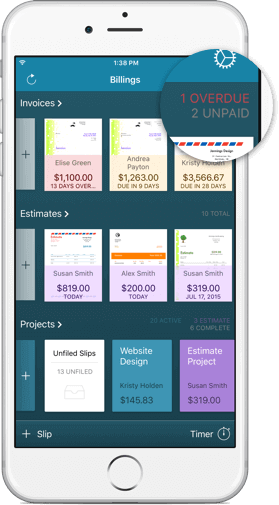
Stay on top of your invoices. See any overdue and unpaid invoices right from the iPhone Home Screen. Swipe to scroll through recent invoices or tap to jump to all.
IMG_0075

Billings Pro 2.2 also offers the ability to view all invoices, estimates, projects and clients, sorting options for clients and invoices, and adds support for Apple Watch OS2. Learn more about Billings Pro 2.2 for iPhone and iPad and read what freelancers and small businesses are loving about Billings Pro.

Twitter stands with Apple

Twitter CEO Jack Dorsey:

We stand with @tim_cook and Apple (and thank him for his leadership)!

It’s about time. Most other companies are too scared to take a stand on this issue. Good for Twitter for standing with Apple.

Apple’s new Trade Up With Installments plan makes it more affordable to upgrade your iPhone

Macworld:

Apple really, really wants you to stop using that old iPhone and to upgrade to a new one. On Thursday, the company announced the Trade Up With Installments plan, the third purchase plan customers can opt into when buying a new iPhone.

The Trade Up With Installments plan is targeted at users of the iPhone 4, 4s, 5, 5c, 5s, 6, and 6 Plus and is only available at the Apple Store. You can bring in your old iPhone and Apple will give you credit for the device, and then you can pay off the new unlocked iPhone in monthly installments.

This sounds like a great plan to get newer iPhones in the hands of those who want the latest and greatest iPhones but just don’t have $600+ to put down upfront. I hope this program is available outside the US.

Apple apologizes and updates iOS to restore iPhones disabled by Error 53

Techcrunch:

Today, Apple is issuing an updated version of iOS 9.2.1 for users that update their iPhones via iTunes only. This update will restore phones ‘bricked’ or disabled by Error 53 and will prevent future iPhones that have had their home button (or the cable) replaced by third party repair centers from being disabled.

A new support document on Apple’s site has been issued that details the causes and repair methods for Error 53.

Good move on Apple’s part to make this right.

The most important Apple executive you’ve never heard of

Bloomberg:

At the center of all this is Srouji, 51, an Israeli who joined Apple after jobs at Intel and IBM. He’s compact, he’s intense, and he speaks Arabic, Hebrew, and French. His English is lightly accented and, when the subject has anything to do with Apple, nonspecific bordering on koanlike. “Hard is good. Easy is a waste of time,” he says when asked about increasingly thin iPhone designs. “The chip architects at Apple are artists, the engineers are wizards,” he answers another question. He’ll elaborate a bit when the topic is general. “When designers say, ‘This is hard,’ ” he says, “my rule of thumb is if it’s not gated by physics, that means it’s hard but doable.”

Those of us old enough to remember the anemic processors in Macs of the past can marvel at the power of the present day chips. It can’t be overstated how important Apple making their own chips is and, therefore, how important this guy is.

Apple’s fight against the FBI

Matthew Panzarino:

The point is that the FBI is asking Apple to crack its own safe, it doesn’t matter how good the locks are if you modify them to be weak after installing them. And once the precedent is set then the opportunity is there for similar requests to be made of all billion or so active iOS devices. Hence the importance of this fight for Apple.

That is exactly right. All devices, even newer ones, will be susceptible if the government is successful.

The wildly misunderstood aeronautics event captured in this photograph

Atlas Obscura:

In the coverage at the time, almost all the media outlets (including Sports Illustrated and World Press Photo) described the image as a physical manifestation of the breaking of the sound barrier. Gay seemed to believe that, telling one interviewer, “I clicked the same time I heard the boom, and I knew I had it.” Other coverage described the cone as a result of the Prandtl-Glauert Singularity, a phenomenon predicting that aerodynamic forces would approach infinity as aircraft neared the sound barrier.

It turns out neither of these are correct. Instead, Gay had captured an effect known as flow-induced vaporization that sometimes forms around objects flying at high speeds in the right environmental conditions.

It’s an amazing photograph that has been around for years and almost always incorrectly described as a “F/A-18 Hornet breaking the sound barrier”. The truth is a lot more complicated.

Apple and fashion: A love story for the digital ages

Vogue:

Apple’s lexicon of pure, pared-down forms, smooth surfaces, gleaming metallic colors, and soft contours within hard carapaces has emerged over the past 20 years under the eye of chief designer Jony Ive. Talking over coffee on the old campus about the growing synergy between the company and the fashion world, Ive points to his rose-gold Apple Watch, a precious counterpoint to the Clarks on his feet.

“Nine years ago, the iPhone didn’t exist, and the most personal product we had was too big to carry around with you,” he explains. “The technology is at last starting to enable something that was the dream of the company from the very beginning—to make technology personal. So personal that you can wear it.”

Apple’s interest in and focus on fashion is really interesting, if potentially a big pitfall. Fashion is notoriously fickle and a misstep could do irreparable harm to the brand.

Why the FBI’s request to Apple will affect civil rights for a generation

Macworld:

Make no mistake: This is unprecedented, and the situation was deliberately engineered by the FBI and Department of Justice to force a showdown that could define limits our civil rights for generations to come. This is an issue with far-reaching implications well beyond a single phone, a single case, or even Apple itself.

As a career security professional, this case has chilling implications.

Mogull is my go-to guy when it comes to security and privacy issues. When he writes, I pay attention. I’ve also got an audio interview with him on tonight’s Your Mac Life show. He’ll be on right after The Loop’s Publisher, Jim Dalrymple.

NASA releases free “Visions of the Future” posters

Imagination is our window into the future. At NASA/JPL we strive to be bold in advancing the edge of possibility so that someday, with the help of new generations of innovators and explorers, these visions of the future can become a reality. As you look through these images of imaginative travel destinations, remember that you can be an architect of the future. Click on any of the thumbnails below to learn more and download a free poster sized image.

Very cool, NASA.

Bad Instagram ads

Om Malik:

Over the past few days, though, I have been contemplating if it is time to get Instagram off my home screen as well. Why? Because it has been infesting my feed with too many ads — and not just any ads but terrible ads. Video ads. Ads that make absolutely no sense to me. Ads that have less relevance to my feed and me than dumb follow-me-everywhere banners on the web.

Sometimes companies force us to make decisions. I’m not saying Instagram shouldn’t have ads, they just shouldn’t allow bad ads.