RTÉ News:
It is understood the protest was in relation to the use by IT companies of coal to power data centres for cloud computing.

RTÉ News:
It is understood the protest was in relation to the use by IT companies of coal to power data centres for cloud computing.
Josh Ong for AppleInsider:
In the report, the organization dismissed Apple’s renewable energy efforts for its Maiden, N.C., server farm as providing just 10 percent of “their total generation.”The Cupertino, Calif., company quickly responded in a statement, according to NPR.“Our data center in North Carolina will draw about 20 megawatts at full capacity, and we are on track to supply more than 60 percent of that power on-site from renewable sources including a solar farm and fuel cell installation which will each be the largest of their kind in the country,” said spokeswoman Kristin Huguet. “We believe this industry-leading project will make Maiden the greenest data center ever built, and it will be joined next year by our new facility in Oregon running on 100 percent renewable energy.”
And then Greenpeace responded. I’d like to see Greenpeace actually do something about the companies that are making no or little effort at all.
Reuters:
Apple Inc and Samsung Electronics Co Ltd agreed that their chief executives would participate in settlement talks to try to resolve a patent lawsuit over smartphone and tablet technology, according to a court filing.
United Continental’s CFO has switched jobs to become a VP of Sales at Apple.
 If you are lucky enough to live in the New York City area, Apple is sending out invites to their “Meet the Filmmakers” series in conjunction with the 2012 Tribeca Film Festival. Filmmakers like Julia Louis-Dreyfus, Brad Hall, Morgan Spurlock and Will Arnett wil be on hand, talking about their latest projects.
The 2012 Tribeca Film Festival runs from April 18th to the 29th.
Apple is allowed to intervene in cases where patent troll Lodsys has gone after App Store developers for violating its patents, which Lodsys says include in-app purchases.
Reached for comment, an Apple spokeswoman said the company is not working on a new product with Starck. If he was working on a project with Apple, he isn’t any more.
A class action lawsuit alleges Apple allowed “bait apps” in the App Store – apps that encouraged users to ring up large amounts of in-app purchases.
“The DOJ’s accusation of collusion against Apple is simply not true. The launch of the iBookstore in 2010 fostered innovation and competition, breaking Amazon’s monopolistic grip on the publishing industry. Since then customers have benefited from eBooks that are more interactive and engaging. Just as we’ve allowed developers to set prices on the App Store, publishers set prices on the iBookstore.”
The New York Times:
The government’s decision to pursue major publishers on antitrust charges has put the Internet retailer Amazon in a powerful position: the nation’s largest bookseller may now get to decide how much an e-book will cost, and the book world is quaking over the potential consequences.Amazon, which already controls about 60 percent of the e-book market, can take a loss on every book it sells to gain market share for its Kindle devices. When it has enough competitive advantage, it can dictate its own terms, something publishers say is beginning to happen.
This is a story with a lot of different angles and repercussions depending on your point of view.
As promised, Apple on Thursday released a utility to remove the most common variants of the Flashback malware. According to Apple the update also configures the Java web plug-in to disable the automatic execution of Java applets. Users may re-enable … Continued
 The Next Web:
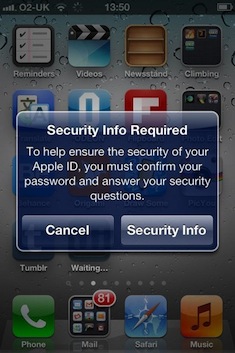
In the past 24 hours, Apple appears to have started prompting iOS devices owners and those with Apple IDs within iTunes to make their accounts more secure, requiring them to pick three security questions and enter their answers when they download a new app.Whilst the new prompt will undoubtedly help secure accounts, many Apple device owners are confused by the new pop-up message and believe it is a phishing attempt.
Great idea from Apple but “springing” this on users without prior knowledge has caused a lot of unnecessary confusion and consternation among users.
The Wall Street Journal:
At the heart of the U.S. government’s suit against Apple and some publishers over e-book pricing is something called “agency pricing.”It’s a term for a new way of setting e-book prices that came about as Apple prepared to introduce its iPad in 2010. Under the traditional “wholesale” pricing model, publishers had long charged booksellers around half the cover price of a book, leaving booksellers to discount the books if they wanted.When Apple entered the fray, it offered publishers the ability to set their own prices.
Good explanation of what the two different pricing models are and how the effect book prices.
Marketplace:
Last week, Marketplace’s Rob Schmitz actually got inside a Foxconn factory in the southern city of Shenzhen. He didn’t meet anybody who was poisoned on the job. He didn’t meet any 13-year-old workers. Nobody he talked to had been hurt in an explosion. He says the stories he heard were more about China than Apple.In the first of two reports, Rob introduces us to the people behind our iPads.
The Apple Store is the place where those experiences are made far better or far worse. Being on the front lines means gathering some great war stories. Stephen is here to share a few of his.
CNET:
The Department of Justice “has a far better case against the publishers than Apple,” says Dominick Armentano, professor emeritus of economics at the University of Hartford and author of Antitrust and Monopoly who’s now affiliated with the Independent Institute in Oakland, Calif. “If the CEOs of the various publishers got together in hotel rooms to discuss prices, they are sunk” and might as well settle, he says.
Jeff John Roberts:
Now, state governments are seeking their own pound of flesh. Connecticut Attorney General George Jepsen has just announced that his state and 15 others have filed an antitrust lawsuit again Apple and five publishers in Texas.
The states say it’s cost consumers $100 million.
WSJ:
The lawsuit, filed in Manhattan federal court by the U.S. Department of Justice’s Antitrust Division, alleges Apple and the publishers reached an agreement where retail price competition would cease, retail e-books prices would increase significantly and Apple would be guarantee a 30% “commission” on each e-book sold.
In response to Flashback malware that’s been in the news lately, Apple on Tuesday revealed that it is developing a tool to detect and remove it. […]
Wall Street Journal:
The nation’s major wireless providers have agreed to a deal with the U.S. government to build a central database of stolen cellphones—part of a broad effort to tame an explosion of thefts nationwide.The database, which the wireless companies will build and maintain, will be designed to track phones that are reported as lost or stolen and deny them voice and data service. The idea is to reduce crime by making it difficult or impossible to actually use a stolen device, reducing resale value.
It will be Cook’s first appearance at D, as well as his first time being onstage at an event not run by Apple or for investors since he was named CEO last August.
Macworld’s Jason Snell opines on the state of iTunes.
Security firm Dr. Web is credited with understanding the scope of Flashback, the Mac botnet malware making the news. But Apple has gotten in the company’s way by blocking a monitoring server.
Trevor Gilbert:
In light of this increase of attention, it’s apparent that the record needs correcting and that someone needs to show that while jingoistic posts may be enticing, they aren’t based in reality.
I have said this before and agree with Trevor.
New York Times:
Apple’s rivals are quick to say how much better, faster, cheaper or more popular their smartphones, computers and tablets are.Yet when it comes to working conditions in the Chinese factories that build these competing products, Apple’s electronics rivals go silent.So why would these electronics makers be so reluctant? They won’t tell us, but Li Qiang, executive director of China Labor Watch had an idea: “Many companies, like H.P., Sony and Dell, don’t publish the full reports because they find violations and problems that are much worse than Apple, and they don’t want the media fallout from the reports.”
As the article says, while Apple may not be a “paragon of open communication”, they are certainly do more and doing it more openly than their competition.
AppleInsider:
After hearing Page’s interpretation of Jobs’s words, Isaacson spoke out this week in a speech at the Royal institution of Great Britain. Isaacson said he felt that Android had ripped off many of his ideas found in the iPhone and iPad, and that his ire was very real, according to Macworld.“It’s almost copied verbatim by Android,” Isaacson said. “And they license it around promiscuously. And then Android starts surpassing Apple in market share, and this totally infuriated him. It wasn’t a matter of money. He said, ‘You can’t pay me off, I’m here to destroy you.'”
It’s time for Google to shut up.
Mat Honan:
Steve Jobs is dead. He doesn’t need to do another day’s work as your puppet pundit. Let the man rest.
Yes, please.
Google CEO Larry Page:
I think that served their interests. For a lot of companies, it’s useful for them to feel like they have an obvious competitor and to rally around that. I personally believe that it’s better to shoot higher. You don’t want to be looking at your competitors. You want to be looking at what’s possible and how to make the world better.
So, Larry looks to make the world a better place and Steve didn’t? Oh please.
CIO Journal:
About 46% of corporations now issue Macs to employees, up by half in just two years, according to a Forrester report. “The use of iPads and iPhones in the workplace is creating increased awareness and consideration of Macs,” said Frank Gillett, vice president and principal analyst at Forrester.Even though more companies are starting to issue Macs, the percent of workers using them is still fairly slim. About 7% of computers companies give to employees are Macs, he said.Macs are the de facto choice of many Silicon Valley startups, and many larger companies now let workers choose a Mac. For example, Cisco CIO Rebecca Jacoby told CIO Journal that about 25% of Cisco’s 63,870 employees use Macs.
Walter Isaacson:
Even though he will not be around to see them to fruition, his rules for success helped him build a company that not only will create these and other disruptive products, but will stand at the intersection of creativity and technology as long as Jobs’s DNA persists at its core.
“as long as Jobs’s DNA persists” may be the key to the future success or failure of Apple.