Apple

95 percent of custom apps developed by businesses are written for Apple devices

The headline says it all. Businesses are investing in the Apple ecosystem, building far more custom apps for iOS than Android.

As a developer, I think no small part of this trend is due to the ease of developing for iOS as compared to Android, as well as the lack of fragmentation device-wise.

Nanigans reports Facebook ads generate significantly more profit on iOS than Android

Nanigans is an ad engine used by companies such as eBay, Zynga, and T-Mobile to advertise on Facebook. Though this article is based on a single report, this is a report worth paying attention to.

In their report, it was noted that, “For the first three quarters of 2013, RPC [revenue per click] on iOS averaged 6.1 times higher than Android and ROI [return on investment] on iOS averaged 17.9 times higher than Android.”

Why the huge difference? iPhone users represent a larger percentage of smartphone web traffic, and spend more money as a group.

Speaking to Businessweek about the mobile industry, Mr. Cook said, “There’s always a large junk part of the market. We’re not in the junk business … There’s a segment of the market that really wants a product that does a lot for them, [emphasis added] and I want to compete like crazy for those customers. I’m not going to lose sleep over that other market, because it’s just not who we are.”

This sounds like arrogance, but it’s really shrewd business. What Mr. Cook is telling us, in other words, is that Apple designs its products for people who aren’t buying bottom of the barrel smartphones. Apple implicitly designs its phones for people who can and do spend money.

WSJ backpedals on alarmist iPhone 5c supply chain story

Amazing to me that journalists (take the term with a grain of salt) like this keep their jobs.

In Apple’s January quarterly earnings conference call, Cook warned analysts, “the supply chain is very complex, and we obviously have multiple sources for things. Even if a particular data point were factual, it would be impossible to interpret that data point as to what it meant for our business.”

Cook continued to recommend that analysts not base their predictions on supply chain “checks” throughout 2013. However, a series of analysts have continued to issue “supply chain check” reports that fueled headlines despite being, more often that not, completely wrong.

And yet this habit continues. Yeesh.

AuthenTec co-founder talks about origins of Touch-ID

I’ve been living with my iPhone 5s for about a week now. I have to say, the fingerprint scanner is incredible. I have two fingers registered, my left thumb (I am left-handed) and my right index finger (for when I use a two handed approach). About 80% of the time, I press and release the home button, and my phone recognizes my touch, opens up instantly. The other 20% of the time, I have to reposition my finger once or twice, and that does the trick. Even in that worst case, I’m in quicker than if I typed in my access code. This is some really well designed technology.

As has been widely reported, Touch-ID is based on technology developed by AuthenTec, a company Apple purchased in July, 2012 for about $356 million.

AuthenTec cofounder Scott Moody gave a presentation this week on the technology behind TouchID.

“We’re looking at pores, structures of ridges and valleys, and instantaneously tell who you are,” Moody said. “Every time you use it, it learns more about you. Because it knows, ‘This is Alex,’ every time you use it gets easier and easier.”

If you’ve ever played with any other fingerprint sensors, you can really appreciate the elegance of the AuthenTec solution. There’s no swiping, no awkward angles. As with all the best tech, it just works.

How to erase and reinstall OS X on your Mac

With some new Mac hardware on the horizon, lots of folks will be replacing their existing machines with brand new gear. And some of them will be giving their existing machines to other folks. If that’s you, take a read of the linked Apple support article. This is the officially sanctioned way to erase and reinstall OS X.

The instructions show you how to erase your hard drive using Disk Utility (you can even do the DoD-approved wipe your drive 7 times method), then use OS X’s built-in recovery disk to reinstall OS X on the wiped drive.

Needless to say, be sure to back up your hard drive before you even read the instructions.

Apple’s new campus gets unanimous city council approval

Good. I love this design, happy to see this project approved.

The approval came after more than six hours of discussion this evening, with many statements of support and some expressions of concern from members of the community, and the approval was met with significant applause by those in attendance.

Today’s approval is final pending any petitions for reconsideration, which must be filed within ten calendar days. If no petitions are received within that period, Apple will be granted ancillary permits to begin demolition of the former HP campus currently located on the site, as well as utility relocation, tree removal, and construction of a temporary sound wall. The formal agreement between Apple and the City of Cupertino must be given a second public reading, scheduled for the council’s meeting on November 19, and Apple’s full set of permits would go into effect the following day.

Sounds like bulldozers on November 20.

iPhone 5s camera review

Professional photographer Austin Mann took an iPhone 5s and iPhone 5 to Patagonia and put both phones through their paces. A good number of side by side shots really tell the story.

The 5S dynamic range… that is, the ability to pull detail out of the shadows & highlights in editing, is remarkably better. I’m constantly sculpting images to bring out the details I want to see… that means bringing up shadows, recovering detail in skies, sharpening where needed and more.

If the camera part of your phone is important to you, read the review, look closely at the pictures. This is a realistic review.

Chevy to add Siri integration to 2014 Camaro, Cruze, Equinox, Malibu, SS and Volt

Connection to the phone will be via Bluetooth, initiated via the steering wheel voice activation button.

To help further minimize distraction, Siri takes hands-free functionality even further with an Eyes Free mode which enables drivers to interact with their iPhones using nothing more than their voice while keeping the device’s screen from lighting up.

Bypassing the screen entirely. Interesting.

Apple hires Burberry CEO as Senior VP of Retail and Online Stores

Tim Cook announced that Angela Ahrendts, CEO of Burberry, will be joining Apple in a newly created position, as a senior vice president and member of the executive team.

Ahrendts will have oversight of the strategic direction, expansion and operation of both Apple retail and online stores, which have redefined the shopping experience for hundreds of millions of customers around the world. Apple retail stores set the standard for customer service with innovative features like the Genius Bar®, Personal Setup and One to One personal training to help customers get the most out of their Apple products.

Ahrendts will start in the Spring. Let’s hope she can bring some stability to the position. Ron Johnson really built the retail foundation at Apple, leaving in 2011 for an ill-fated run at JC Penney. John Browett replaced Johnson, but was at Apple less than a year.

App for girls to rank boys

Would this app be allowed if it was boys ranking girls? Aren’t there privacy issues galore here? Remember FaceMash, the ranking web site that eventually morphed into Facebook? Isn’t this the same sort of thing? Hmmm…

Apple iWorks apps free with new iOS devices

Apple sent out a $20 iTunes credit to folks who bought a new iOS device after September 1st and then went on to purchase iMovie, iPhoto, Numbers, Pages, or Keynote, effectively making those purchases a true bargain.

Leaving aside the mathematics of $20 versus the regular price of those apps, I wondered if those apps are now free, did a little digging.

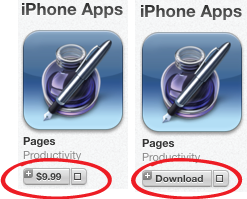
Interesting. I launched iTunes on my Mac, went to the App Store in iTunes, and did a search for Pages (I did not own a copy of Pages at this point). As expected, Pages showed up on the iTunes account on my Mac showing the full price of $9.99.

I pulled out my new iPhone (activated in the past week) and searched for Pages in the App Store on my phone. Huzzah! On my phone, Pages was free. Quick, before Apple could change their minds, I downloaded Pages.

Back on my Mac, in iTunes, the price of the app changed from $9.99 to “Downloaded”, showing that I now own the app. Cool!

Pages

I repeated the process and now have all 5 of these apps on my iPhone and, soon, will have them on my iPad as well. Way to go Apple.

Jonathan Ive and Marc Newson interview

Jonathan Ive you know. One of his best friends, Marc Newson, might not be quite as familiar a name to you. Newson is also a world-class designer. The two are collaborating for the first time for an auction to benefit Bono’s Product (Red) anti-H.I.V. campaign. Vanity Fair interviewed them both.

In an effort that is part connoisseurship, part creativity, and part curatorship, the two designers have assembled a group of more than 40 objects that will be auctioned at Sotheby’s in New York on November 23 to benefit Product (Red), the eccentrically punctuated charity set up by Bono and Bobby Shriver in 2006 to support international efforts to fight the H.I.V. epidemic in Africa. Two one-of-a-kind pieces—a metal desk and a special Leica camera—were designed by Ive and Newson in collaboration, specially for the auction. Several others, like a customized Steinway grand piano and a Georg Jensen silver pitcher, are variations on existing objects that Ive and Newson both liked and got the manufacturers to agree to tweak for the sale, generally by adding something red. (The Steinway appears to be entirely white, but when you lift its lid, the underside turns out to be painted an intense, brilliant red, while the pitcher has a red enameled interior.) A few other items, such as a circa-1990 Russian cosmonaut’s space suit and a sketch for one of Elvis Presley’s stage costumes from 1970, are objects Ive and Newson found and decided that they liked well enough to include in the auction as is.

On obsession with detail and commitment to design:

“We are both fanatical in terms of care and attention to things people don’t see immediately,” Ive said. “It’s like finishing the back of a drawer. Nobody’s going to see it, but you do it anyway. Products are a form of communication—they demonstrate your value system, what you care about.”

On the one-of-a-kind Leica camera the pair designed for the auction:

The camera is based on the Leica Digital Rangefinder and was manufactured by that company as a custom item. The overall shape is similar to a conventional camera’s, but the finished object looks altogether different. It is made of brushed aluminum, and the controls are sleek and understated, as on Ive’s products for Apple. It does everything the regular Leica does, with the same lenses and the same functions, but the controls no longer seem intrusive, like silver barnacles on a black metal beast. Instead, every button and every lever is a tiny sensual moment, subsumed into the overall form of the camera. Never a thing of beauty, the Leica has become one by being boiled down to its essence.

“I found it a very odd and unusual thing to put this amount of love and energy into one thing, where you are only going to make one,” Ive said. “But isn’t it beautiful?” The camera’s dollar worth is hard to estimate, since it is an art piece as much as a functioning object, but the value of the time Ive, Newson, and Leica’s own engineers put into it probably totals well into six figures, and possibly seven. The process of designing and making the camera took more than nine months, and involved 947 different prototype parts and 561 different models before the design was completed. According to Apple, 55 engineers assisted at some part in the process, spending a collective total of 2,149 hours on the project. Final assembly of the actual camera took one engineer 50 hours, the equivalent of more than six workdays, all of which makes Ive’s comment to me that he thought the Leica might bring $6 million seem not so far-fetched.

Good read, especially if you are into design.

PC market falls 8%, Apple year-over-year market share drops slightly

Gartner and IDC released their quarterly PC shipment numbers. No tablet data, no phone data, just personal computers. Lots to chew on. Some highlights from Gartner’s US numbers:

  • The big winner in all this seems to be Lenovo. They trail Apple in units shipped, but increased their market share by 24.6%.
  • Apple’s year-over-year market share fell 2.3% to 13.4%.
  • Apple’s 3rd quarter market share showed growth over Q2, going from 11.6% to 13.4%. 3rd quarter numbers are traditionally stronger, as it is the back-to-school quarter.
  • To me, there are two big takeaways from this. First, tablets are cannibalizing PC sales. No big news there. Second, I see any decline in Apple sales as a sign of the aging of Apple’s Mac line. The iMac and MacBook Air refreshes are recent and the Mac Pro and Macbook Pro lines are due, hopefully soon. My instinct here is that we’ll see a nice bounce in the numbers, starting with Q4.

    Cloud-based MacPaint simulation

    Today seems to be live-in-the-past day. Heh.

    For you young-‘uns, MacPaint was a bit-mapped drawing program that shipped with the original Macintosh. A lovely bit of code.

    iPad and iPhone usage remains strong among US teens

    Piper Jaffray analyst Gene Munster just released data from their latest semiannual teen survey. Interesting read. Three things jumped out at me. In the three survey periods (Fall ’12, Spring ’13, Fall ’13):

    1. iPhone ownership climbed steadily (40%, 48%, 55%). Shocking numbers for a device Samsung portrays as uncool.
    2. Expected next phone purchase: iPhone as next phone increased (62%, 62%, 65%). Android also increased, but with a much smaller share (22%, 23%, 24%).
    3. On the tablet side, Android marketshare is growing (plan to buy an Android table: 16%, 24%, 28%), while iPad plus iPad Mini drops (75%, 68%, 64%). Why add iPad and iPad Mini? Seems right, since Android does not break out their numbers by form factor.

    My gut reaction to the tablet numbers is that the tablet share change is due to the ongoing maturation of the tablet market. The iPad mini was not around for the first survey and Android tablet use is still finding its level, at the cost of the existing iPad. Looking forward to the next survey.

    1985 Macintosh calendar

    From the most excellent Scott Knaster:

    Last week I posted about MAC: The Macintosh Calendar 1985 and included a couple of images from the calendar. Lots of folks asked to see more, so today I photographed the entire calendar and posted it. I apologize in advance to anyone depicted in this calendar who would rather not see these images again. It’s all done in the name of history.

    Click on the calendar picture to jump to the gallery. You can zoom in once with the magnifying glass, then again with the + sign in the mini picture in the upper left corner.

    Such great memories.

    10 mobile app design tips

    Design tips worth reading before you start your next app project. These aren’t perfect, they aren’t exhaustive, but good food for thought.

    Why Apple may win the gaming market

    Apple is on the precipice of making real inroads into the gaming market. Certainly, there’s no question that there is a thriving iOS gaming market, but the vast majority of those are casual games at low price points. There are a number of compelling factors that might signal a real change in the balance of power between iOS and the consoles. Between SpriteKit and native iOS support for real gaming controllers, the only real barrier I see is a lack of storage space. Certainly not an issue on the Mac side, but how can a programmer access 50 Gb of cut scenes from an iPad or iPhone, even one connected to a TV. Wonder if some kind of network storage peripheral could solve this problem.

    A bit heavy on conjecture, this is a good read nonetheless.

    Secrets of the iOS 7 keyboard

    Some terrific shortcuts here. My favorite:

    Typing punctuation can be a drag on an iOS device. Take the humble question mark. First, you must tap 123 key to get to the number and punctuation keyboard, then tap the question-mark (?) key, and then tap the ABC key to get back to the letter keyboard.

    Here’s a quicker way to do it. Tap and hold the 123 key. Now, without removing your finger from the keyboard, slide your finger over to the question-mark key (or any other punctuation mark) and then release. The keyboard will insert your symbol and automatically switch back to the ABC keyboard.

    This trick is even better if you want to type a special mark, such as the upside-down question mark (¿).

    SEC ends review of Apple taxes

    Four months after raising questions about Apple’s foreign earnings and taxes, the U.S. Securities and Exchange Commission has ended its investigation without plans to take any further action.

    Apple adds iPhone tips page

    Apple added an iPhone tips page to their site. Created and named for the iPhone 5s, the page’s tips seem useful for all iOS 7 users.

    Tesla, the fire, the market, and Apple

    Tesla founder Elon Musk knows from success. Musk started and sold Zip2, a web software company, pulling $22 million out of that sale. He rolled that into the company that ultimately brought PayPal to market, got about $175 million in stock when eBay bought PayPal. He used that nest egg to create Space Exploration Technologies (SpaceX) in 2002 and to fund Tesla Motors in 2004. Nothing but hits.

    A lot has been written over the past few days about a fire in one of Tesla’s cars. A video of a burning Tesla S went viral, creating a large PR problem for the company.

    Elon Musk took the wheel on this, so to speak. He wrote a calm narrative that laid out the facts, as he saw them. If you have any interest in electric cars, take a minute to read Musk’s blog post. Here’s how the accident happened:

    Earlier this week, a Model S traveling at highway speed struck a large metal object, causing significant damage to the vehicle. A curved section that fell off a semi-trailer was recovered from the roadway near where the accident occurred and, according to the road crew that was on the scene, appears to be the culprit. The geometry of the object caused a powerful lever action as it went under the car, punching upward and impaling the Model S with a peak force on the order of 25 tons. Only a force of this magnitude would be strong enough to punch a 3 inch diameter hole through the quarter inch armor plate protecting the base of the vehicle.

    Clearly, this accident was no fault of the car design.

    The Model S owner was nonetheless able to exit the highway as instructed by the onboard alert system, bring the car to a stop and depart the vehicle without injury. A fire caused by the impact began in the front battery module – the battery pack has a total of 16 modules – but was contained to the front section of the car by internal firewalls within the pack. Vents built into the battery pack directed the flames down towards the road and away from the vehicle.

    Read the rest of the post. The car is designed with safety in mind. Certainly no more dangerous than any of its gasoline-filled brethren.

    So how does the market react? From the linked article:

    Tesla’s stock had been on a tear after the company announced its first quarterly net profit and began expanding into Asia and Europe this year. But share prices declined 6.2 percent, to 180.95, the day the video was released, and kept falling the next day. (It closed Friday at $180.98.)

    To be fair, if you read the article, there were a number of factors that influenced the market reaction. But I think the timing of that stock plummet rests largely on the release of the video showing the burning Tesla S. The market reacts quickly to news, slowly to reason.

    Apple shares a common fate with Tesla in this regard. Some of the news that impacts Apple’s stock price appears made up of whole cloth, based purely on an analyst’s misunderstanding of market forces. That is unfortunate. Personally, I want people like Elon Musk, Tim Cook, Jony Ive, and Craig Federighi to worry less about analysts and spend their time making great products.

    Security firm says iPhone bug can thwart remote wipe

    When you are at or near the top of a market, you become a target. Microsoft lived that life for many years. Now, the emergence of the mobile market has shifted the spotlight, as well as the security risk, over to iOS and Android. Though the rigor of Apple’s app inspection and certification process does keep the iOS app ecosystem significantly safer than Android, iOS devices are just as highly valued a target for hackers.

    The point is, these attacks are going to keep coming. Apple’s job is to keep tweaking their processes to keep the bad guys at bay. So far, Apple has done their job well.

    This new attack takes advantage of a flaw in the “Find my iPhone” process. The video below does an excellent job laying out the scenario. In a nutshell, the thief steals an iPhone and immediately turns on airplane mode to prevent the iPhone from being remotely wiped. This gives the thief enough time to break into your phone and use your credentials to reset your Apple ID password, take control of your phone, Apple account, and other accounts.

    The video also offers 5 suggestions for fixing this problem:

    1. Apple should make Airplane Mode inaccessible from the lock screen by default and require a passcode – not just a fingerprint – any time Airplane Mode was activated or the SIM card was removed

    2. During Apple ID creation, Apple should warn users not to store credentials to password-reset accounts on their registered devices

    3. On Find My iPhone, Apple should differentiate between likely-temporary and likely-permanent loss scenarios, and in the latter, should advise users to immediately revoke the devices’s access to all accounts it has credentials for, e.g. email-, social media-, and telephony accounts

    4. The iOS lock screen should not display whether the phone is protected by a simple 4-digit PIN or a more complex passcode, and on devices with Touch ID, it should not display whether fingerprint authentication is being used

    5. Upon reconnecting to the Internet, iOS should not allow email retrieval before the device’s wipe- or don’t-wipe status can be retrieved

    As with every other legitimate problem of this nature that Apple has faced, the problem has a fix. No doubt, Apple will do their analysis, find the best possible fix, and roll it out quickly so we can all sleep safely again.

    DPReview posts detailed review of iPhone 5s camera

    Long time fan of Digital Photography Review. It’s my first stop before I buy any new piece of photography gear. Agree with them or not, there is always something to learn from their reviews.

    Their final word:

    The iPhone 5s, running Apple’s fresh iOS 7, is an excellent phone with a very good camera. Image quality under most conditions is among the top of the class of “conventional” smartphone camera units: you have to look to the Nokia Lumia 1020 to find something that’s hands-down better across the board, though in good light the best 13-megapixel sensors do capture more detail.

    The camera app is supremely easy to use, and the 5s’ powerful processing makes for class-leading burst speed and excellent responsiveness. Users looking to upgrade from older iPhones shouldn’t be disappointed. That said, there’s nothing in the 5s that changes the fundamental balance of power in the mobile photography world: users committed to other OSes won’t necessarily see a reason to switch.

    About what you’d expect, I think. To really get a sense of the iPhone 5s camera, take a look at the gallery of 78 images at the end of the review. To see a particular image at full size, download the original (click the link at the bottom right of the image). In my opinion, some of these shots are stunning.

    Potential sanctions against Samsung

    From Florian Mueller’s patent blog:

    Three months ago I saw a filing by Nokia that related to some discussions with Samsung considered so secretive that it wanted even the very title of a document to be sealed. It was clear that Nokia and Samsung were talking about something that also related somehow to the 2011 Nokia-Apple settlement, about the terms of which nothing was known except that Apple described it, at a very high level, as “merely a ‘provisional license’ for a limited ‘standstill’ period”. One could figure that Nokia and Samsung wouldn’t talk about some other patent agreement without talking about some sort of patent deal between them — a license or an outright purchase.

    On Wednesday evening local time, Magistrate Judge Paul S. Grewal of the United States District Court for the Northern District of California, whose writing style is well-liked by various patent litigation watchers including me, entered an order that finally sheds light on this. The order came down after a hearing held yesterday on a request by Apple (and possibly also one by Nokia) for sanctions against Samsung (and/or its outside counsel) for violation of a protective order, i.e., for illegal disclosure of (in this case, extremely) confidential business information.

    I must say that I’m shocked.

    The big question here is this:

    So how did Samsung’s executives get access to contracts that were meant to be used only by its outside counsel (marked as “Highly Confidential — Attorneys’ Eyes Only”) for the purposes of litigation with Apple and absolutely positively not for the pupose of gaining unfair advantages in licensing negotiations with anyone (not with Apple, and much less with third parties like Nokia), when such disclosure would constitute an unbelievably serious violation of court rules?

    It will be interesting to see how this plays out. These are pretty serious accusations.

    Reinventing Microsoft

    Big days of change are clearly ahead for Microsoft. The Board of Directors has some big decisions to make as the largest activist investors are applying pressure to see their particular agenda enacted.

    The main issue is that Ballmer himself is leaving Microsoft in the next 12 months — he offered a tearful goodbye to employees at last week’s annual companywide meeting — and finding a new CEO to execute such a dramatic shift in the company’s strategy while maintaining its existing 16 billion-dollar businesses will be no easy task.

    That task has been made substantially more difficult in recent days by activist investors — reports surfaced last week that a group made up of “three of the top 20 investors” was pushing for Ford CEO Alan Mulally to take over the top spot, and yesterday news leaked that Microsoft’s board was seriously considering him. At the same time, “three of the top 20 investors” were also credited yesterday with pushing to remove Bill Gates from the Microsoft board, which he currently chairs. That would include his removal from the CEO search committee, which is presumably moving forward on the Mulally recommendation at the same time. None of that feels particularly suited to a smooth transition.

    Every time I hear someone complaining about Apple’s lack of innovation or pending doom or the crime of having too much cash, I just think about Microsoft, Dell, and Blackberry and thank heavens for Tim Cook and the rest of the team.