Apple

Apple’s solar farms in North Carolina

Katie Fehrenbacher for GigaOM:

Apple’s two solar farms and one fuel cell farm near its data center in North Carolina are now all live and generating power. The projects are unprecedented in the industry and have helped usher in real change.

What a fascinating read.

Customize the iOS Music app

Did you know you can customize the tab bar at the bottom of the iOS Music app? By default, it offers tabs labeled Radio, Playlists, Artists, Songs, and More. Want to replace the Radio tab with a Genre tab? Easy. Follow the link and Kirkville will show you how.

Siri and flight status

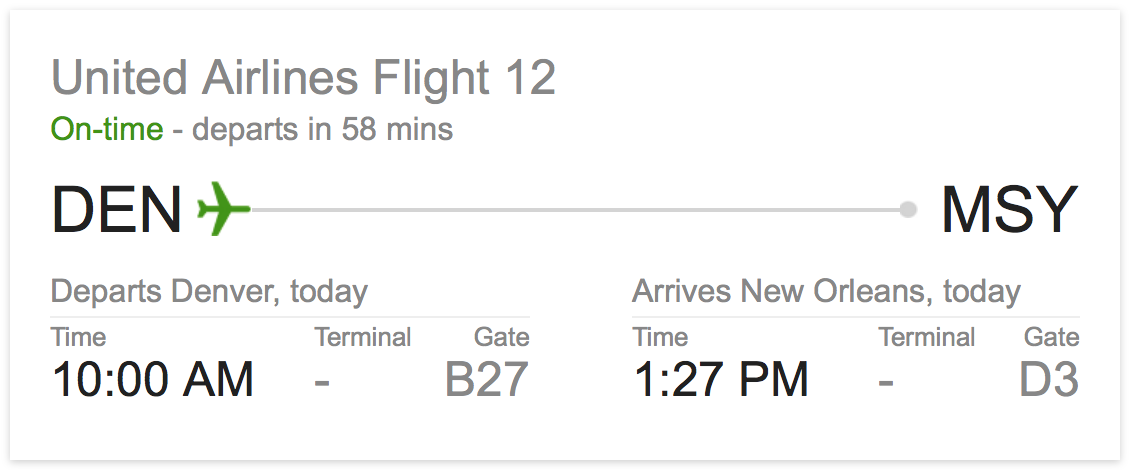
I love Siri. There are so many positives, I hate to gripe. But flight status is low hanging fruit and something Siri should be able to do quite easily. Here’s an example.

Bring up a Google search and type:

united airlines flight 12

In reply, you’ll see something like this:

flight status

This is very helpful. When I press-and-hold for Siri, say, “united airlines flight 12” or “flight status united airlines flight 12”, I get a list of web searches. Even if one of those web searches led me to the exact search I was looking for, this is an unambiguous query. To me, Siri should know that I want the flight status of a specific flight and go get it.

To be fair, I can say this to Siri:

Google search united airlines flight 12

This will, indeed, give the results I seek. But Siri shouldn’t need that sort of assistance. At the very least, when I say “flight status”, Siri should know what I want and how to get it. More importantly, Siri should not have to depend on Google for this type of request.

All that said, Siri is still a marvel and does an awful lot that I find useful. Perhaps file this one under suggestion instead of complaint. But please fix it either way. I’ve got flights to track.

The details in the Samsung Apple patent retrial

There’s been a lot of coverage on the Apple Samsung patent retrial. This article does a good job of boiling down both the numbers and the arguments being put forth by each side.

Samsung’s expert’s key argument:

An expert hired by Apple had determined the company was due $114 million in lost profits because of Samsung’s use of technology under Apple’s patent No. 7,844,915, also known as “pinch to zoom.” The ‘915 patent covers technology that can distinguish whether a user is scrolling with one finger versus using several touch points at once for a pinch-to-zoom action.

However, Michael Wagner, an accountant and lawyer hired by Samsung, said there’s no evidence from either company that shows consumers bought Samsung devices because they liked that particular touch-screen feature. As a result, he believes Apple should receive no money for lost profits.

“I believe people bought these phones for other features,” Wagner said. That includes bigger, AMOLED screens; faster processors; and 4G LTE.

And from Apple’s side:

One expert, MIT professor John Hauser, estimated three Apple patents, including the ‘915 patent, adds about $100 in value to a $199 smartphone or $90 in value to a $499 tablet. [Apple’s accountant, Julie] Davis said Apple lost out on $114 million in profits because of the Samsung copycat devices. She also calculated Samsung’s profits to be $231 million, and said reasonable royalties owed to Apple total $35 million. Apple estimates it would have sold 360,000 devices if Samsung hadn’t released infringing rivals.

The article also covers the “lost profits” aspects of this precedent setting case.

The real story behind tablet market share reporting

This is some incredible compelling analysis. I would urge anyone interested in the methodology behind PC/tablet/phone market share “reporting” (and I do use that term loosely) to read this top-to-bottom.

Things start off with a bit of history.

Following a routine that began in the 1990s, Gartner and IDC spent the 2000s noting that Apple’s Mac market share was virtually irrelevant, afloat in an ocean of PC sales without giving much regard to the fact that Apple enjoyed very high share in some market segments (such as education and graphic design) and essentially none in others (such as enterprise sales, kiosks and cash registers).

Then came the iPod, then the iPhone, then the iPad, with Mac sales rising as the Mac-iOS ecosystem evolved and expanded.

And that’s when this article really gets interesting. In a nutshell, a case is made that IDC, Gartner, and Strategy Analytics (the big three) set out to torpedo Apple’s perceived market share.

There’s little mystery of who shot down the iPad’s market share or what weapon they’re using: all three major market research firms rapidly fire off headline bullets clearly aimed at wounding the perception of Apple’s tablet. One can, generally, only speculate about why this is occurring.

However, Strategy Analytics has offered some unusual transparency regarding its motive for carving out a very specific market and then stuffing the pie chart with “tier two” volume to the point where the world’s best selling tablet is crushed down into an embarrassing statistical sliver of shrinking “share.”

Read the article. Fantastic.

Video of Steve Jobs being inducted into BAC biz hall of fame

Nice mix of video, speeches, interviews.

It includes several tributes to Steve Jobs from various Silicon Valley luminaries, including Oracle CEO Larry Ellison (who was also inducted), Bill “Coach” Campbell, and others.

Worth watching.

Former Microsoft CTO builds an iPad-exclusive app

This is a pretty interesting story, one that goes beyond the headline. Former Microsoft CTO Nathan Myhrvold did indeed build a beautiful cooking app, bypassing Android and, more notably, the Surface, to focus exclusively on the iPad. Makes sense to me. Android is a tough nut to crack and the iPad has that beautiful Retina display.

But there’s more to Myhrvold than that.

In addition to crafting culinary literature, Myhrvold cofounded Intellectual Ventures, a patent acquisition and licensing business that’s earned him the pejorative of “patent troll” from his critics over the past decade.

Yup. Those guys. Here’s a link to the wiki page. Hard to reconcile these pieces. Microsoft CTO, founder of Microsoft Research, founder of IV, and cooking genius who loves the iPad. Who’da thought?

Jony Ive book looks good, just lighten up on the marketing

I think the world of Jony Ive. When I heard that Leander Kahney was working on a book about Sir Jonathan, I got excited. But this marketing approach is over the top. Watch the video trailer below. It ends with this line:

Did we give credit to the wrong guy?

Yeesh. Big splash of cold water. The book deserves better than this.

Samsung admits guilt, but huge gap on what they offer, what Apple asks for

Last fall, Samsung was found guilty of infringing on five Apple patents. We’re now at the start of the patent damages retrial.

This is what Apple is asking for:

Apple is seeking $113 million in lost profits for 360,000 iPhones the company believes it could have sold without competing against its own work, another $231 million in improper profits collected by Samsung on its own sales, and $34 million in patent royalties for the intellectual property Samsung infringed, a total of $379 million.

And this is what Samsung proposes:

Samsung argued that it earned “nowhere close” to $3.5 billion on the infringing devices, instead stating that it earned only $52 million. “And that, he says, is what Apple should get in damages,” Mintz reported. Additionally, Samsung proposed paying Apple nothing for lost profits and just $28,000 for patent royalties.

Obviously, this is a negotiation. You wouldn’t expect Samsung to play this any differently. Time will tell.

Apple II DOS source code available for download

This is where it all started for me, my first exposure to Apple. The first bit of money I ever made was writing a game called Library Adventure for the Apple II. Much of the code was written with peeks (to access hidden bits of the OS) and pokes (to hide our own stuff for later retrieval) in memory. We used packages from PenguinSoft and Beagle Brothers. Pulled many all nighters and had a grand old time.

Now the Computer History Museum and Digibarn Museum have released the Apple II DOS code into the wild (non-commercial use only). Here’s the link if you want to grab a copy for yourself. As of this writing, the server returned an internal error. I suspect the servers have been overwhelmed with requests.

. Such sweet memories.

Some iPad Mini Retina WiFi models available for in-store pickup

This morning, no models were showing as available for in-store pickup. That has now changed. For example, I’m seeing the 64GB and 128GB Silver and Space Gray WiFi models as available for pickup in my local Apple Store, even though both show 5-10 day shipping.

As always, check with your local store, your mileage may vary.

iPad Mini now on sale, not for in-store pickup

Ran a little Twitter survey this morning. The new Retina mini appears to be available for purchase now in the US, Australia, Canada, Singapore and throughout much of Europe. That’s who I’ve heard from so far. Poll results show shipping in 1-3 days for the WiFi model, 5-10 days for the cellular model, though Belgium, Denmark, France, Luxembourg, Netherlands, Spain, and Switzerland show shipping as 5-10 days for both models. The models range from 16GB up to 128GB.

In the US online Apple Store, as of 6:30 am ET, the 16GB and 32GB WiFi-only models show as ready to ship in 1-3 days and everything else is marked to ship in 5-10 days.

The evolution of the iPhone

Interesting infographic. Take a look, see if it all looks right to you, then read the comment below it.

Review of the iPad Air personal hotspot

Took the iPad Air personal hotspot for a spin this morning. Could not have been a more positive experience.

I travel a lot, and frequently find myself without a net connection. Some of what I do can be done on a cellular iPad, but there are many times when I need to work on my laptop. In the past, I’ve turned to personal hotspots from various carriers, but I’ve never been happy with the reliability and the cost is high for the bandwidth you get.

The iPad Air data plan is $50 per month for 5GB of data. My previous data plan was $30 for 3GB and I rarely used more than 500MB. I look at this as paying an extra $20 per month for the hot spot. Not quite right, but close enough. I’m used to paying between $45-$75 per month for other cellular hotspot solutions. On the cost side, this is a bargain, assuming you can live with the 5GB limit. For me, this is not an issue.

Setup is a breeze, far simpler than any hotspot I’ve ever used. On your iPad, go to Settings / Personal Hotspot and tap the switch to turn it on. That’s it. You’ll have the choice of using the hotspot over WiFi, USB (plug the iPad into your computer) or Bluetooth (you’ll be prompted to enable Bluetooth – I did not do that). Your hotspot will come with a default password that is different for each iPad. Tap on the password to change it.

Back on your computer, the iPad WiFi will appear in the list of WiFi networks as the name of your iPad. For me, the iPad appeared as “Dave Mark iPad Air”. I joined the network, typed in the password, and I was in.

The network speed is fast. I ran a benchmark and found the speed to be about 9MB download and 2.25MB upload. Not as fast as FiOS but still pretty zippy. I did not notice any slowdown when sending emails or browsing the web. Obviously, file downloads will be slower, relative to my broadband connection, but that’s to be expected.

I had a friend log in with a Windows machine and her experience was just as positive. She was able to play World of Warcraft and not notice a bit of difference between WoW on broadband and WoW on a hotspot.

Bottom line, the personal hotspot on my iPad Air is a home run. Simply brilliant.

BlackBerry board rejects break-up proposals from Apple, others

According to Reuters, BlackBerry’s board has had discussions with Apple, Microsoft, Cisco, Google, Lenovo and others about selling BlackBerry intellectual property, similar to the patent purchases from bankrupt Nortel back in 2011.

Hands on with the Xbox One, a living room of possibility

If Apple is going to make inroads into the console gaming space, this is an experience they will have to exceed. The Kinect voice recognition has gotten better than on the 360 (as you’d expect), and more solidly integrates with the OS.

Voice controls are now a system-level process that runs in the background while you’re using an app or game. You can call out, “Xbox, snap friends” while playing a game to bring up your friends list on the side of the screen, without even pausing. Then there are the handy app-specific shortcuts activated by voice commands. “Xbox, watch Comedy Central” let me jump straight to watching the channel even from another app, for instance.

This is certainly a step towards the magical computer/living room holy grail of integration. Just a step, since this is not a desktop experience. You won’t be editing documents or creating emails on your Xbox One. But definitely a solid step forward.

Aside from voice, the most significant system-level feature enabled by the Kinect is the ability of the Xbox One to log a user in automatically based only on their visuals. The first time you set up the system, it takes you through a 30-second process where you log in to your Microsoft account. Kinect then builds a personal profile it will associate with that account based on facial recognition but also the camera’s basic skeletal model of your body. This process forms a unique biometric ID that the Kinect uses to automatically identify a user, logging them in to Xbox Live and bringing up a personalized menu that includes their recent apps and favorite items.

Another step forward. Touch ID works well on a phone and is a solid security solution. But it is still an active solution (meaning you need to take an action to achieve your goal). The ability to walk up to your Xbox One and have it automatically log you in is a passive solution. Remains to be seen how secure this form of biometric profiling is, but not so sure security is as big a requirement in the living room, where you have more control over physical access than you do with your laptop or phone.

The process of unlocking your device based on some form of biometric has lots of room for improvement and is a real opportunity for the company that gets it right. There are keyless deadbolts for your front door that allow you to unlock your front door remotely via a Bluetooth signal from your phone. There’s an app that lets you knock on your phone to unlock your computer, also accomplished via Bluetooth (read the comments before you buy).

Point is, this is a wide-open, wildly innovative field. Apple has a real opportunity here. The living room is like the Wild West. Still untamed, still full of possibility.

Apple Stores to offer limited range of in-store iPhone 5s & 5c repairs

Traditionally, if you brought your damaged iPhone in to an Apple Store for repair, they would have to give you a brand new (to you, at least) phone, then send your damaged phone out for repair or recycling.

According to 9to5 Mac (see the headline link), that process has changed for the iPhone 5c and 5s.

Apple is gearing up to soon begin hardware repairs for the iPhone 5s and iPhone 5c in its chain of retail stores, according to sources with knowledge of the upcoming initiative. These sources say that Apple Stores will be able to replace several parts of the iPhone 5s and iPhone 5c on-site, meaning that Apple will no-longer need to fully replace iPhone 5s and iPhone 5c units with damage or other problems…

The sources say that Apple will be providing its stores with special machinery to replace the touchscreens on both the iPhone 5s and iPhone 5c. These machines will be used specifically to calibrate the displays. The screen replacements cost $149 for each device, and this price point is significantly more affordable than the several-hundred dollars required to completely replace a device with a damaged/cracked screen.

In addition to displays, Apple will have the capability to replace the volume buttons, vibrating motor, rear-camera, and speaker system on the iPhone 5s and iPhone 5c. Apple Stores will be able to replace the conventional Home button on the iPhone 5c, but it does not appear that Apple will be able to conduct swaps for the Touch ID-based button on the iPhone 5s

This is good news all around. Better for the environment, and a potentially cheaper and faster path for an out of warranty problem with your phone.

The big picture on Samsung’s smartphone sales

Thoughtful analysis on the nature of Samsung’s smartphone sales.

In a meeting with its concerned investors on Wednesday, the head of Samsung Mobile revealed numbers illustrating that the company sold fewer high end smartphones than Apple this year, and that only about a third of the company’s total “smartphone” shipments are of a class really comparable to the iPhone.

This is a problem for Samsung. They are seeing the beginning of market saturation for their high-end smartphones, are relying on older/lesser model sales to bolster revenues. With minimal exceptions, all of Apple’s phone sales are high-end smartphones. And that’s where the margins are. Hard for Samsung to keep this going, especially without making inroads on battery life and processing power (still no 64-bit devices).

Lots to absorb, worth a read.

Apple releases “Report on Government Information Requests”

We believe that our customers have a right to understand how their personal information is handled, and we consider it our responsibility to provide them with the best privacy protections available. Apple has prepared this report on the requests we receive from governments seeking information about individual users or devices in the interest of transparency for our customers around the world.

Apple to build sapphire glass manufacturing plant in Arizona

Apple is repurposing this First Solar facility to create sapphire glass:

Apple will build a new 700-employee manufacturing facility in Mesa, Arizona, to make sapphire glass, according to releases from the State of Arizona and GT Advanced, a New Hampshire-based materials manufacturing company. Apple purchased the vacant manufacturing building from First Solar, and has contracted with GT Advanced to “own and operate furnaces and related equipment” at the facility.

Question is, how will Apple use sapphire glass. An alternative to Corning’s Gorilla Glass 3 for smart-phones? As a crystal for a smart-watch? Time will tell.

Nike Move+ app goes live, takes advantage of iPhone 5s M7 motion chip

First shown off in October’s iPhone 5s rollout, the Nike Move+ app went live yesterday. If you’ve got an iPhone 5s, you can take advantage of the app to see where and how much you move during the day. I suspect this is the first of many such apps that will take advantage of the M7 motion coprocessor. Another marketing discriminator for the iPhone 5s.

Apple VP of iOS Engineering, Henri Lamiraux, retires

Lamiraux leaves behind a strong legacy.

Lamiraux first joined Apple in 1990 as a software engineer for the Mac platform, which would later be renamed OS X. In 2000, he earned a managerial position for OS X platform experience before becoming director of engineering for that department in 2004.

In 2005, he switched over to iOS under the important Apps and Frameworks section as director of software engineering, and became vice president of the department in September 2009.

Lamiraux reported directly to Craig Federighi and retired once he shipped iOS 7.0.3.

Apple’s stealth attack on the consoles

Kyle Richter paints a picture here, projecting Apple’s path to a seat at the console table.

Apple has sold roughly 700 Million iOS devices since the introduction of the original iPhone, in addition they have sold in excess of 13 Million Apple TVs. Compare that to the 78 Million (as of March 2013) PlayStation 3′s sold since it was released in 2006, and 78.2 Million Xbox 360′s sold from its release in 2005 through June 2013. It is no wonder that the iPod touch (and iPhone) is considered one of the world’s leading gaming platform, with roughly 9x the sales of traditional consoles. When looking at the number of available titles, Xbox 360 comes in with 958 games, PS3 with 793 available games, and iOS with an almost unbelievable 166,510 games. Yes, the average quality of an Xbox or Playstation game is higher than that of the average iOS game, but that is a trend that we as developers can change. The average Xbox game sells for $24.60, while the average Playstation 3 game sells for $28.92, once again the almost unbelievable number for average iOS game price is 76¢. So, Apple has significantly more devices, with an exponentially larger game selection, at a fraction of the cost. This is a good position to be starting from.

This is just the starting point. Read the whole thing. Agree or disagree, this is excellent food for thought.

iPhone now available on contract for first time in world’s second largest wireless market

The iPhone has long been available in India, but only at its full, unsubsidized price.

The contract system, which is widely prevalent in other parts of the world, is a rarity in India. Telecom operators in India don’t subsidize the handset for their subscribers as the lack of a universal data base–such as the U.S.’s social security number–makes it difficult to track users and determine their credit worthiness.

Reliance Communications, then known as Reliance Infocomm Ltd., had partnered with LG Electronics Inc., Samsung Electronics Co., and Nokia Corp., to offer subscribers a handset at a huge subsidy. A Nokia handset that cost about 10,000 rupees ($161) in the retail market was given to users for an upfront payment of a mere 501 rupees. The offer drew about a million new subscriptions within 10 days of the launch, but consumers dumped the phone and switched service providers) after a few months, leaving Reliance Communications with massive losses.

This time, Reliance Communications is minimizing its risks by tying up with credit card companies, which will be responsible for the billing. People without credit cards can’t sign up for the offer.

If this succeeds, this could be a big win for Apple.

T-Mobile and the confusing iPad rollout

I applaud T-Mobile’s efforts to make their way into the already crowded iPhone and iPad space. But this iPad rollout just strikes me as ham-handed:

T-Mobile CEO John Legere tweeted today to clarify his company’s free 200MB monthly plans for iPads on its network. He reiterated that “everyone” gets 200MB of free data with no strings attached.

Earlier today, customers trying to buy iPads on T-Mobile were told they would have to pay a $10 monthly fee to access the “free” data, contradicting an offer from last week.

That is a sure way to squander any good-will gained. If your plan is to buy your way into the market using the iPad data plan as a loss-leader, then get the word out to your staff, make sure everyone is on the same page.

Google isn’t innocent in the patent wars

John Gruber:

But Motorola — a wholly-owned Google subsidiary — has filed patent lawsuits against Apple all over the world. Just one month ago Apple finally put an end to an 18-month injunction that prevented iCloud users in Germany from getting push notifications for email — because of a patent lawsuit filed by Google.

I’m in total agreement with Gruber on this one. Like most people, I hate these stupid patent trolls, but too many people are trying to make Google seem like a victim here. They’re not.