
Any maths geek will certainly recognize the term fractals, the set of numbers that are infinitely recursive and self similar. This short film gives you the chance to meet the father of the fractal, Benoit Mandelbrot.
AnandTech review of the iPad Mini Retina
Anand Lal Shimpi compares the new Mini with both last year’s model and the new iPad Air.
Stanford researchers invent self-healing battery
Increasing the storage density of batteries is one problem. Extending the lifespan of a battery is another. This Stanford linear accelerator lab work may have just made a leap forward in both of these areas.
Researchers have made the first battery electrode that heals itself, opening a new and potentially commercially viable path for making the next generation of lithium ion batteries for electric cars, cell phones and other devices. The secret is a stretchy polymer that coats the electrode, binds it together and spontaneously heals tiny cracks that develop during battery operation
Researchers worldwide are racing to find ways to store more energy in the negative electrodes of lithium ion batteries to achieve higher performance while reducing weight. One of the most promising electrode materials is silicon; it has a high capacity for soaking up lithium ions from the battery fluid during charging and then releasing them when the battery is put to work.
But this high capacity comes at a price: Silicon electrodes swell to three times normal size and shrink back down again each time the battery charges and discharges, and the brittle material soon cracks and falls apart, degrading battery performance.
”We found that silicon electrodes lasted 10 times longer when coated with the self-healing polymer, which repaired any cracks within just a few hours.”
The best Star Wars furniture that Imperial Credits can buy
Heh. These are pretty well done.
Customize the iOS Music app
Did you know you can customize the tab bar at the bottom of the iOS Music app? By default, it offers tabs labeled Radio, Playlists, Artists, Songs, and More. Want to replace the Radio tab with a Genre tab? Easy. Follow the link and Kirkville will show you how.
iPad stand you can fit in your pocket
The TwoHands iPad stand from Felix is like a long, thin hair clip. Squeeze the short end and the legs grasp the sides of the iPad. Works on most tablets, in portrait and landscape. Love this design. Also love the domain name. Presumably felix.com was already taken. This is a good second choice.
Siri and flight status
I love Siri. There are so many positives, I hate to gripe. But flight status is low hanging fruit and something Siri should be able to do quite easily. Here’s an example.
Bring up a Google search and type:
united airlines flight 12
In reply, you’ll see something like this:
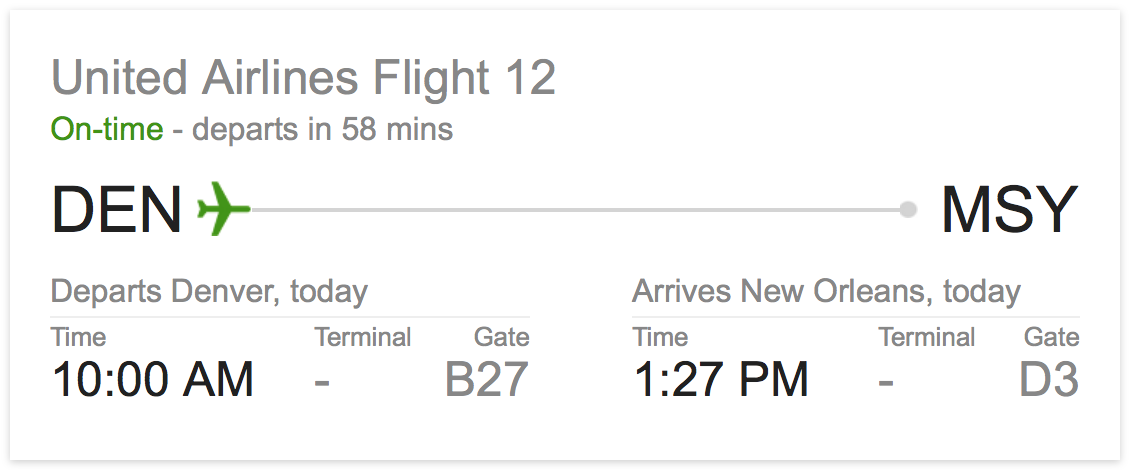
This is very helpful. When I press-and-hold for Siri, say, “united airlines flight 12” or “flight status united airlines flight 12”, I get a list of web searches. Even if one of those web searches led me to the exact search I was looking for, this is an unambiguous query. To me, Siri should know that I want the flight status of a specific flight and go get it.
To be fair, I can say this to Siri:
Google search united airlines flight 12
This will, indeed, give the results I seek. But Siri shouldn’t need that sort of assistance. At the very least, when I say “flight status”, Siri should know what I want and how to get it. More importantly, Siri should not have to depend on Google for this type of request.
All that said, Siri is still a marvel and does an awful lot that I find useful. Perhaps file this one under suggestion instead of complaint. But please fix it either way. I’ve got flights to track.
Coin, the all-in-one card
Coin is an editable card that holds all of your credit/debit and loyalty cards. Fascinating.
Stores using location tech to assist (and follow) shoppers
Scenarios like this one are becoming more and more common as location tech gains a foothold in retail:
You’ve just tossed a jar of peanut butter in your grocery cart when your smartphone buzzes. You glance down at the screen to see a message that seems downright clairvoyant: Buy some jelly. Get $1 off.
Convenient? Certainly. Creepy? Maybe.
In September, Apple introduced the iBeacon. But retailers are exploring many other options for indoor positioning and tracking, including low-power Bluetooth (used by the iBeacon and others), videocameras, sound waves, and magnetic fields. The goal is to enhance the brick and mortar experience to rival that of online retailers.
The technology could eventually give retailers capabilities rivaling those of online stores. On the Web, behavioral ads use records of a person’s browsing history to propose products. Now pharmacies or home improvement stores wanting to sell Kleenex or two-by-fours could soon do the same thing (see “It’s All E-Commerce Now”).
“Not much is known about what shoppers do in stores until they check out at the cashier,” says Todd Sherman, chief marketing officer for Point Inside, a Bellevue, Washington, startup that’s among a score of companies that have raised venture capital funding to perfect indoor tracking and advertising techniques. “This way, you can see what they’re interested in [and] see where they’re going.”
The data culled from shopper cell phones can be incredibly useful.
Forest City Enterprises triangulates on cellular signals to monitor foot traffic in most of the nearly 20 shopping centers it owns or manages. It says the data helped it decide where to move an escalator that was interfering with an entrance. The company also measures how long visitors stay after a fashion show or concert. Stephanie Shriver-Engdahl, Forest City’s vice president of digital strategy, says the company wants to know, “Do they get one soda, hop in the car, and leave? Or are they staying longer?” In the future, foot-traffic data could be used to set lease prices, she says.
There is an obvious convenience to buying online. But brick and mortar has benefits as well and traditional retailers are focusing on enhancing the experiences storefronts offer that cannot be matched by online merchants.
The details in the Samsung Apple patent retrial
There’s been a lot of coverage on the Apple Samsung patent retrial. This article does a good job of boiling down both the numbers and the arguments being put forth by each side.
Samsung’s expert’s key argument:
An expert hired by Apple had determined the company was due $114 million in lost profits because of Samsung’s use of technology under Apple’s patent No. 7,844,915, also known as “pinch to zoom.” The ‘915 patent covers technology that can distinguish whether a user is scrolling with one finger versus using several touch points at once for a pinch-to-zoom action.
However, Michael Wagner, an accountant and lawyer hired by Samsung, said there’s no evidence from either company that shows consumers bought Samsung devices because they liked that particular touch-screen feature. As a result, he believes Apple should receive no money for lost profits.
“I believe people bought these phones for other features,” Wagner said. That includes bigger, AMOLED screens; faster processors; and 4G LTE.
And from Apple’s side:
One expert, MIT professor John Hauser, estimated three Apple patents, including the ‘915 patent, adds about $100 in value to a $199 smartphone or $90 in value to a $499 tablet. [Apple’s accountant, Julie] Davis said Apple lost out on $114 million in profits because of the Samsung copycat devices. She also calculated Samsung’s profits to be $231 million, and said reasonable royalties owed to Apple total $35 million. Apple estimates it would have sold 360,000 devices if Samsung hadn’t released infringing rivals.
The article also covers the “lost profits” aspects of this precedent setting case.
The real story behind tablet market share reporting
This is some incredible compelling analysis. I would urge anyone interested in the methodology behind PC/tablet/phone market share “reporting” (and I do use that term loosely) to read this top-to-bottom.
Things start off with a bit of history.
Following a routine that began in the 1990s, Gartner and IDC spent the 2000s noting that Apple’s Mac market share was virtually irrelevant, afloat in an ocean of PC sales without giving much regard to the fact that Apple enjoyed very high share in some market segments (such as education and graphic design) and essentially none in others (such as enterprise sales, kiosks and cash registers).
Then came the iPod, then the iPhone, then the iPad, with Mac sales rising as the Mac-iOS ecosystem evolved and expanded.
And that’s when this article really gets interesting. In a nutshell, a case is made that IDC, Gartner, and Strategy Analytics (the big three) set out to torpedo Apple’s perceived market share.
There’s little mystery of who shot down the iPad’s market share or what weapon they’re using: all three major market research firms rapidly fire off headline bullets clearly aimed at wounding the perception of Apple’s tablet. One can, generally, only speculate about why this is occurring.
However, Strategy Analytics has offered some unusual transparency regarding its motive for carving out a very specific market and then stuffing the pie chart with “tier two” volume to the point where the world’s best selling tablet is crushed down into an embarrassing statistical sliver of shrinking “share.”
Read the article. Fantastic.
Video of Steve Jobs being inducted into BAC biz hall of fame
Nice mix of video, speeches, interviews.
It includes several tributes to Steve Jobs from various Silicon Valley luminaries, including Oracle CEO Larry Ellison (who was also inducted), Bill “Coach” Campbell, and others.
Worth watching.
Former Microsoft CTO builds an iPad-exclusive app
This is a pretty interesting story, one that goes beyond the headline. Former Microsoft CTO Nathan Myhrvold did indeed build a beautiful cooking app, bypassing Android and, more notably, the Surface, to focus exclusively on the iPad. Makes sense to me. Android is a tough nut to crack and the iPad has that beautiful Retina display.
But there’s more to Myhrvold than that.
In addition to crafting culinary literature, Myhrvold cofounded Intellectual Ventures, a patent acquisition and licensing business that’s earned him the pejorative of “patent troll” from his critics over the past decade.
Yup. Those guys. Here’s a link to the wiki page. Hard to reconcile these pieces. Microsoft CTO, founder of Microsoft Research, founder of IV, and cooking genius who loves the iPad. Who’da thought?
The PS4 is about to make one giant leap forward
Watch this demo. Ignore the silliness and focus on the quality and content of the demo. To me, this is a huge step forward in bringing forward thinking technologies from the lab and niche apps into the mainstream. The interesting stuff comes in at about 1:20. The app is called Playroom and is built-in to the PS4. The down side is that it requires the PS4 camera (a $60 add-on).
The cynics among you will dismiss this as a ploy to sell the camera (the Xbox One equivalent is included in the box). Perhaps. But no matter the motive, this is still some mighty cool tech.
Renault’s remotely brickable car
When you buy a car, you expect it to come with a battery. Not with Renault’s new electric Zoe. You have to rent the battery. And, supposedly, if you don’t pay the monthly rental fee, Renault can remotely prevent your battery from charging.
It’s part of a larger product strategy through which the Zoe collects huge amounts of data on your driving and ships it all back to the manufacturer.
I can’t imagine this strategy being successful. Who would buy into this scheme?
Heartwarming Google ad
Nicely done.
Jony Ive book looks good, just lighten up on the marketing
I think the world of Jony Ive. When I heard that Leander Kahney was working on a book about Sir Jonathan, I got excited. But this marketing approach is over the top. Watch the video trailer below. It ends with this line:
Did we give credit to the wrong guy?
Yeesh. Big splash of cold water. The book deserves better than this.
A cave so huge it has its own weather system
The Er Wang Dong cave system was discovered in China’s Chongquing province. It’s huge, covering more than 50,000 square meters. More importantly, some of the caverns are tall enough to have their own weather systems. Follow the headline link. The pictures are phenomenal.
Samsung admits guilt, but huge gap on what they offer, what Apple asks for
Last fall, Samsung was found guilty of infringing on five Apple patents. We’re now at the start of the patent damages retrial.
This is what Apple is asking for:
Apple is seeking $113 million in lost profits for 360,000 iPhones the company believes it could have sold without competing against its own work, another $231 million in improper profits collected by Samsung on its own sales, and $34 million in patent royalties for the intellectual property Samsung infringed, a total of $379 million.
And this is what Samsung proposes:
Samsung argued that it earned “nowhere close” to $3.5 billion on the infringing devices, instead stating that it earned only $52 million. “And that, he says, is what Apple should get in damages,” Mintz reported. Additionally, Samsung proposed paying Apple nothing for lost profits and just $28,000 for patent royalties.
Obviously, this is a negotiation. You wouldn’t expect Samsung to play this any differently. Time will tell.
Evan Spiegel, the 23 year old face of Snapchat
It’s rare for someone to fly under the radar from startup to a billion dollar valuation. Even rarer for a founder who is only 23 years old. Snapchat was started by Stanford students Evan Spiegel and Bobby Murphy in September 2011, in Spiegel’s father’s living room. Spiegel has emerged as the face of Snapchat.
A lot has been written about Snapchat’s supposedly turning $3 billion from Facebook. The headline link takes you to an example. To me, more interesting is the video below, a September 2013 interview with Spiegel at Disrupt SF:2013. Amazing how much Spiegel has matured in just 6 months. He clearly has been getting some excellent advice from his handlers. The big question for Snapchat is, can they turn the corner and generate revenue?
Living on a prayer at TD Garden
Yeah, this is a fan.
Incredible Academy Award winning short film from 1959
Not sure if it’s the imagery, the music, or just the rhythm of the whole piece, but this is ten minutes well spent. I love the faces of the glass-blowers as they puff out their cheeks, sometimes smoking a pipe at the same time. Lovely.
Glas won master film maker Bert Haanstra a well-deserved Academy Award® for Best Short Documentary in 1959. The film contrasts the production of hand made crystal from the Royal Leerdam Glass Factory with automated bottle making machines in the Netherlands. An industrial film with a bebop heart, its lyrical use of light and sound still looks and sounds fabulous, nearly 60 years after it was made.
Driverless electric cars are here, more coming
Welcome to the future. If you are flying through London’s Heathrow Airport, be on the lookout for the UltraPRT pods, little electric vehicles that run on a closed road, taking passengers from terminal to terminal, all with no driver. And Heathrow is not alone. A town in Buckinghamshire is about to get a fleet of taxis that follow a similar model. Google’s autonomous research program has a fleet of very recognizable Priuses and Lexuses out on the road as well. The closed loop model used by Heathrow is how this technology will spread. Good stuff.
MacRumors site hacked, some user data exposed
If you’ve got a MacRumors forum account, change your password and change the password for any other accounts that use the same password.
Apple II DOS source code available for download
This is where it all started for me, my first exposure to Apple. The first bit of money I ever made was writing a game called Library Adventure for the Apple II. Much of the code was written with peeks (to access hidden bits of the OS) and pokes (to hide our own stuff for later retrieval) in memory. We used packages from PenguinSoft and Beagle Brothers. Pulled many all nighters and had a grand old time.
Now the Computer History Museum and Digibarn Museum have released the Apple II DOS code into the wild (non-commercial use only). Here’s the link if you want to grab a copy for yourself. As of this writing, the server returned an internal error. I suspect the servers have been overwhelmed with requests.
The Register’s take on the iPad Air
Hard not to like the iPad Air. It’s got an incredible screen, it’s light, it’s fast. Yup, they like it too.
The invisible bicycle helmet
This is an amazing invention. So very brilliant.
Some iPad Mini Retina WiFi models available for in-store pickup
This morning, no models were showing as available for in-store pickup. That has now changed. For example, I’m seeing the 64GB and 128GB Silver and Space Gray WiFi models as available for pickup in my local Apple Store, even though both show 5-10 day shipping.
As always, check with your local store, your mileage may vary.
Statistics on the life span of a hard drive
Pretty interesting study on the statistical failure rate of hard drives. Have you backed up your drive recently?
Mavericks tip: Use Quicklook to open a document in a different app
This is a pretty useful tip, new to me. Click on a document in the Finder, then hit space to open the Quicklook preview. In the upper-right corner, you’ll see a button that says “Open with xxx” where xxx is the default application for that document type. If you press and hold the button, you’ll see a list of other applications that will also open your document.
Nice.